Understanding Power Station Efficiency: Why Rated Wh Never Equals Usable AC Energy
Learn why rated battery capacity is always higher than delivered AC watt-hours, how inverter idle draw shrinks low-load runtime, and what third-party tests reveal.
Rated battery capacity (Wh) measures raw internal DC cell storage, whereas usable AC output is always lower due to DC-to-AC conversion heat, continuous inverter standby draw, BMS safety buffers, and cooling fans. Moderately loaded compact units can exceed 90% in third-party tests (such as 705–730.59 Wh on the 768Wh BLUETTI AC70), while tiny intermittent loads on huge 240V inverters incur much steeper standby overhead.

Key Technical Takeaways
- No portable power station delivers 100% of its rated DC battery watt-hours out of its AC wall outlets.
- Four losses reduce usable AC output: DC-to-AC inverter conversion heat, continuous inverter standby idle draw, BMS safety buffers, and cooling fan/electronics draw.
- Low continuous loads (such as a 25W router or intermittent fridge) lose a much higher percentage on large 240V inverters than on compact units—use DC/USB-C outputs whenever possible.
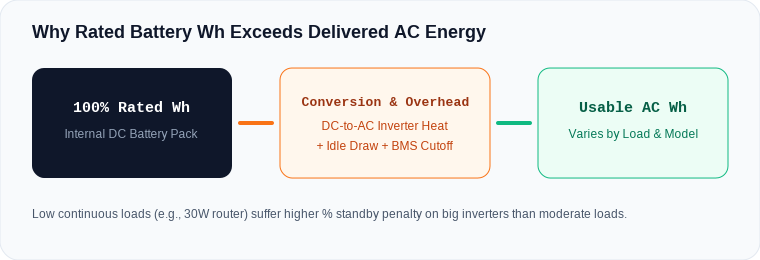
One of the most common disappointments for first-time power station buyers is watching a 1,024Wh battery run out after delivering only 800–880 Wh of household AC power—or seeing a huge 3,840Wh 240V backup station drain faster on a refrigerator than a smaller 2,048Wh unit. This discrepancy is not a battery defect; it is basic electrical physics.
Understanding where energy disappears between internal DC lithium cells and AC wall outlets allows you to size runtime accurately and avoid overpaying for capacity that gets burned as inverter heat.
The Four Sources of Power Station Energy Loss
Every portable power station stores energy inside low-voltage DC battery cells (typically 24V to 51.2V nominal, or higher in modular stacks). To run a standard 120V or 240V household plug, energy passes through several lossy stages:
- DC-to-AC Inverter Conversion Loss (~5%–12%): Stepping low-voltage DC up to high-voltage 120V/240V pure sine wave AC requires high-frequency switching MOSFETs and transformers, releasing heat—especially near very low loads or maximum inverter output.
- Inverter Idle / No-Load Overhead (10W–60W+ Continuous): Simply pressing the “AC On” button keeps control boards, gate drivers, and split-phase transformers energized continuously. Even if your connected load draws only 30W—or zero watts while a refrigerator compressor rests between cycles—the inverter burns standby power every hour it stays awake.
- BMS Top & Bottom Protective Buffers (~3%–8%): A Battery Management System intentionally stops discharge slightly above absolute cell zero (and caps full charge slightly below absolute maximum) to protect LiFePO4 longevity across 3,000–4,000 cycles.
- Cooling Fans, Wi-Fi Radios & Display Draw: Internal telemetry, Wi-Fi/Bluetooth modules, LCD screens, and temperature-triggered cooling fans consume small continuous DC loads drawn directly from the pack.
What Verified Third-Party Lab Data Actually Shows
Rather than guessing a flat universal multiplier (such as assuming every unit delivers 85%), we track attributed third-party discharge tests directly in our registry:
| Model (Rated Capacity) | Third-Party Tester & Conditions | Measured Outcome | Key Efficiency Lesson |
|---|---|---|---|
| BLUETTI AC70 (768 Wh) | APH Networks (136W steady AC load) |
730.59 Wh delivered (~92.5% net inverter efficiency / ~95% cell discharge) | Moderate steady loads near 15%–35% of inverter rating maximize AC efficiency. |
| BLUETTI AC70 (768 Wh) | PowerOffGrid (250W steady AC load) |
705 Wh delivered (~91.8% of rated Wh / ~90% system efficiency) | Higher wattage slightly increases thermal/conversion heat while staying >90% efficient. |
| BLUETTI AC200L (2,048 Wh) | CNET Labs (Round-Trip Efficiency & Fridge Test) | 77.76% RTE; >29 hours standardized refrigerator test | Controlled 120V-only inverter overhead preserves runtime across intermittent fridge cycling. |
| Anker SOLIX F3800 (3,840 Wh) | CNET Labs (Standardized Fridge Test) | ~25.68 hours standardized refrigerator test | Large 6,000W 120V/240V dual-voltage inverter standby draw consumes far more energy over 24+ hours than smaller single-voltage inverters. |
Transparency Note: For models in our database that do not yet have verified third-party usable-AC-Wh measurements in sources.json, our Runtime Calculator applies an explicit 78%–88% AC range (or 72%–84% when powering sub-150W loads on 3,800W+ 240V units) instead of pretending a single exact number applies to every model and load.
Why Inverter Size vs. Load Size Matters So Much
Suppose an inverter draws 45W just to stay switched on (common on large split-phase units), whereas a compact 1,000W inverter draws 12W idle:
- If both run a 500W power tool or heavy microwave load, 45W vs. 12W idle overhead only changes efficiency by a few percentage points.
- If both run a 35W router or CPAP machine overnight via AC, the compact unit burns
35W + 12W = 47Wtotal (~74% goes to your device), while the massive split-phase unit burns35W + 45W = 80Wtotal—over 56% of battery drain goes strictly into keeping the big inverter awake!
This is why owning a smaller compact power station (or using DC ports directly) alongside a whole-home 240V unit often stretches multi-day blackout survival dramatically.
How to Maximize Usable Energy From Any Power Station
- Use USB-C PD and Regulated 12V DC Instead of AC: Modern USB-C laptops (up to 140W on the Anker SOLIX C300, EcoFlow DELTA 3 Plus, and DJI Power 1000), DC-powered CPAP rigs (with manufacturer-approved DC adapters), and 12V camp fridges bypass the DC-to-AC inverter entirely, typically delivering an estimated 88%–93% of battery energy.
- Switch Off the AC Inverter Button When Unused: Leaving AC outlets toggled on overnight with nothing plugged in silently drains battery reserves every hour.
- Avoid Charging Other Batteries Over AC: If your phone, laptop, or RV house battery can charge over DC or USB-C, avoid converting Battery DC -> 120V AC -> Charger Brick DC, which compounds two conversion losses.
- Evaluate Value on Both Rated and Usable Wh: Test real street prices in our Price per Wh Calculator, and read our deep dive on Why Rated Wh Never Equals Usable AC Energy.

Frequently Asked Questions
Why shouldn't I just multiply every power station's capacity by 0.85 to estimate runtime?+
A flat 85% efficiency rule ignores how dramatically inverter standby overhead changes with load size and inverter capacity. A compact 1,000W inverter powering a 200W load might deliver ~90% usable AC energy, whereas a 6,000W dual-voltage inverter running a 35W load for 24 hours can lose over a third of its stored energy just keeping its own inverter circuits awake.
Which models in your database have independently measured usable AC Wh figures?+
In our verified source registry, the BLUETTI AC70 was measured at 730.59 Wh usable AC output at 136W (APH Networks) and 705 Wh at 250W (PowerOffGrid) from its 768Wh pack, while CNET Labs measured 77.76% round-trip efficiency and >29 hours refrigerator runtime on the BLUETTI AC200L (compared to ~25.68 hours on the Anker SOLIX F3800). Models without verified third-party discharge data are clearly labeled as estimates.
How can I reduce conversion losses during a power outage?+
Turn off the AC inverter button whenever you only need USB-C, USB-A, or 12V DC ports; power laptops, Starlink hardware (with approved DC kits), routers, and compatible CPAP units via DC/USB-C; and avoid using oversized 240V split-phase stations for tiny overnight loads when a compact unit can handle them.
Sources & Technical References
- View Source →[1]Third-Party Independent ReviewAPH NetworksVerified 2026-11-24BLUETTI AC70 Portable Power Station Load Test Review
Constant 136W AC load discharge test measured 730.59 Wh usable output (~95% of rated 768Wh cell capacity; ~92.5% net inverter efficiency).
- View Source →[2]Third-Party Independent ReviewPowerOffGridVerified 2026-11-24BLUETTI AC70 Usable AC Capacity & Inverter Efficiency Test
250W continuous resistive load AC discharge test recorded 705 Wh usable AC output (~90% overall system efficiency).
- View Source →[3]Third-Party Independent ReviewCNETVerified 2026-11-24CNET Portable Power Station Lab Efficiency & Refrigerator Runtime Benchmarks
Documents standardized refrigerator runtime and round-trip efficiency testing including BLUETTI AC200L (77.76% RTE, >29h fridge test) and Anker SOLIX F3800 (~25.68h fridge stress runtime due to dual-voltage inverter overhead).
- View Source →[4]Manufacturer SpecificationBLUETTI US OfficialVerified 2026-11-24BLUETTI AC70 Portable Power Station Official Specifications
768Wh LFP, 1,000W continuous AC, 2,000W Power Lifting resistive mode, 500W MPPT solar (12-58V, 10A), 950W Turbo AC charge.
- View Source →[5]Manufacturer SpecificationBLUETTI US OfficialVerified 2026-11-24BLUETTI AC200L Portable Power Station Official Specifications
2,048Wh LFP, 2,400W continuous AC, 3,600W Power Lifting mode, NEMA TT-30R + 48V/8A DC RV port, 1,200W solar (12-145V).
- View Source →[6]Manufacturer SpecificationAnker SOLIX US OfficialVerified 2026-11-24Anker SOLIX F3800 Portable Power Station Official Specifications
North American model specs including NEMA 14-50R, L14-30R, 6,000W output, 3,840Wh capacity, and 11-60V dual solar input.