Anker SOLIX F3800 Review (2026): Wheeled 6,000W 240V Backup & F3800 Plus Revision Notes
Anker SOLIX F3800 US review: 3,840Wh LFP, 6,000W 120V/240V NEMA 14-50R/L14-30R ports, CNET fridge test overhead, and F3800 vs F3800 Plus limits.
The Anker SOLIX F3800 remains one of the most straightforward plug-and-play 120V/240V wheeled units thanks to built-in NEMA 14-50R and L14-30R outlets, 6,000W continuous output, and ~$2,999 street pricing. However, CNET refrigerator testing reveals higher inverter idle overhead on light intermittent loads, and the original F3800 caps solar voltage at 60V Voc—a constraint buyers must weigh against the newer F3800 Plus (165V Voc) and higher-capacity 240V rivals.

Original F3800 frequently retails around $2,999–$3,399 vs $3,999 launch MSRP; verify Plus vs original SKU ($0.78/rated Wh at street pricing).
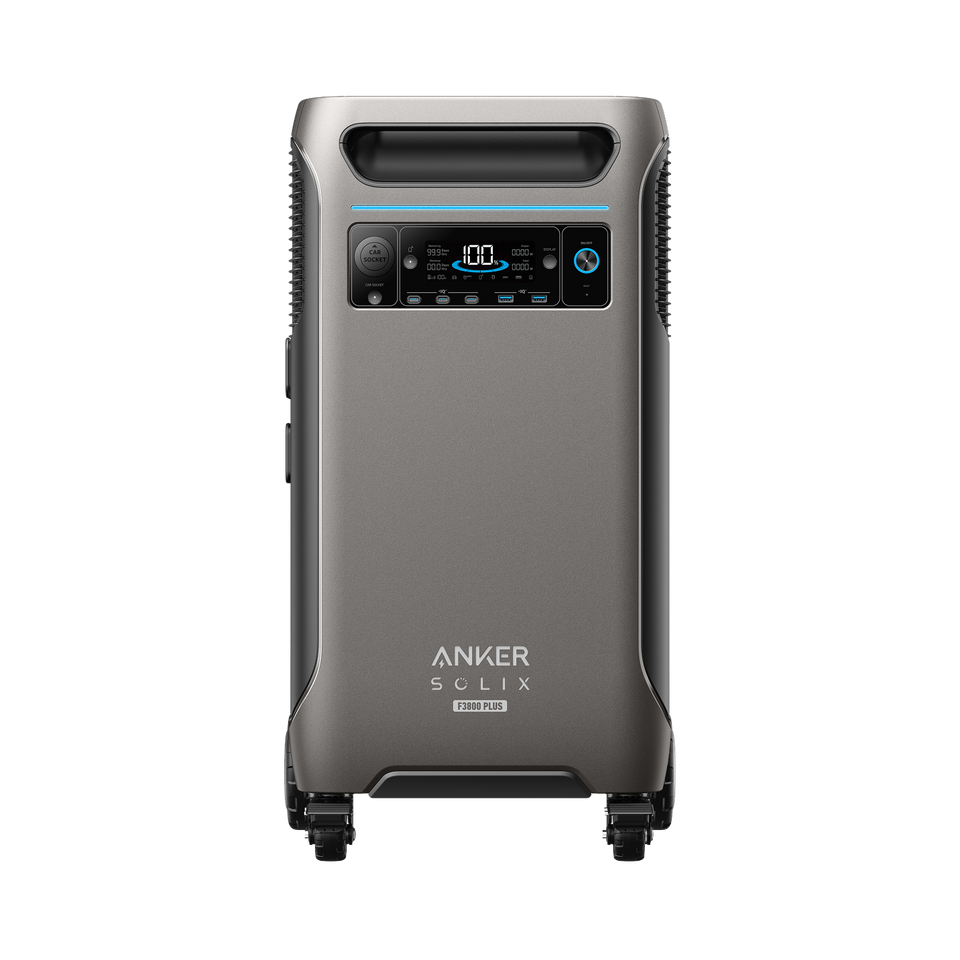
Official Hardware & Application Gallery
Sourced from Anker SOLIX official product media 
Key Advantages
- ✓Direct 120V/240V NEMA 14-50R and L14-30R outlets without external inverter hub boxes
- ✓Wheeled suitcase geometry simplifies garage-to-transfer-inlet repositioning
- ✓Competitive street pricing around $2,999 for a 3,840Wh split-phase LFP unit
Trade-offs & Limitations
- !132.3 lbs single-piece weight makes lifting into trucks a two-person job
- !Original F3800 solar input stops at 60V Voc (addressed by the newer F3800 Plus up to 165V)
- !CNET testing highlights higher inverter idle consumption under intermittent fridge loads
Ideal Applications
- Homeowners pairing a single wheeled 240V battery with a manual transfer switch or inlet box
- EV owners seeking emergency Level 2 backup range extension via NEMA 14-50R
Situations Where It May Not Fit
- High-voltage rooftop solar strings over 60V Voc (unless choosing F3800 Plus or DELTA Pro Ultra)
- Multi-day low-wattage runs where 6,000W inverter idle draw reduces usable Wh efficiency
Complete Verified Specifications
| Specification | Verified Data | Data Provenance |
|---|---|---|
| Product Name & Revision | Anker SOLIX F3800 (Original F3800 (note: F3800 Plus revision also exists in US market)) | Manufacturer Spec |
| US Market Version | US 120V/240V Edition (Model A1790) | Manufacturer Spec |
| Battery Capacity (Rated) | 3,840 Wh | Manufacturer Spec |
| Measured Usable AC Output | Not Independently Verified | Unverified |
| Battery Chemistry | LiFePO4 (LFP) | Manufacturer Spec |
| Published Cycle Life | 3,000 cycles to 80% original capacity — Manufacturer rating under standard 25°C cycling conditions | Manufacturer Spec |
| Continuous AC Output | 6,000 W (Not Applicable (native 6,000W continuous dual-voltage output)) | Manufacturer Spec |
| Published Surge Output | 9,000 W | Manufacturer Spec |
| Published Surge Duration | Not Disclosed (brief startup surge rating; exact duration not published in summary specs) | Not Disclosed |
| AC Output Voltage | 120V / 240V Split-Phase | Manufacturer Spec |
| AC Outlet Types | 6 × 120V 20A NEMA 5-20R (3 with UPS bypass support); 1 × 120V/240V NEMA 14-50R (EV/Appliance port); 1 × 120V/240V NEMA L14-30R twist-lock (RV/Transfer switch) | Manufacturer Spec |
| USB-A Output | 2 × USB-A (12W max each) | Manufacturer Spec |
| USB-C Output | 3 × USB-C PD (100W max each) | Manufacturer Spec |
| DC Output Ports | 1 × 12V/10A Car Socket (120W max) | Manufacturer Spec |
| Max Solar Input | 2,400 W | Manufacturer Spec |
| Solar Input Voltage Range (Voc) | 11V–60V Voc per dual XT60 port (Note: F3800 Plus expands to 11V–165V / 3,200W) | Manufacturer Spec |
| Solar Input Current Limit | 25A max per port (1,200W × 2) | Manufacturer Spec |
| MPPT Configuration | Dual MPPT controllers (1,200W per channel) | Manufacturer Spec |
| AC Charging Rate | 1,800 W max — Up to 1,800W via standard 120V/15A US wall outlet (~2.7 hrs estimated wall charge) | Manufacturer Spec |
| Car / Alternator Charging | 120W max via 12V car socket | Manufacturer Spec |
| Published Recharge Time | Approx. 2.7 hrs on 1,800W AC or ~1.5–2 hrs under peak 2,400W solar conditions | Mfr / Attributed Test |
| Expandable Capacity | Yes — up to 53,760 Wh (Expandable to 26.88kWh with 6 × BP3800 batteries per unit; 53.76kWh across two parallel units) | Manufacturer Spec |
| Supported Expansion Batteries | Anker SOLIX BP3800 Expansion Battery (3,840Wh) | Manufacturer Spec |
| UPS / EPS Functionality | Automatic EPS/UPS backup on designated 120V outlets | Manufacturer Spec |
| Published Switching Time | <20 ms (manufacturer rated) | Manufacturer Spec |
| Weight | 132.3 lbs (Single-chassis wheeled suitcase unit (~60 kg) with telescopic handle) | Manufacturer Spec |
| Dimensions (L × W × H) | 27.6 × 15.1 × 14.6 in (including 2.56-in wheels) | Manufacturer Spec |
| Operating Temp (Charging) | 32°F to 104°F (0°C to 40°C) | Manufacturer Spec |
| Operating Temp (Discharging) | -4°F to 104°F (-20°C to 40°C) | Manufacturer Spec |
| Noise Rating (Manufacturer) | Not Disclosed (specific dB figure not listed in primary spec sheet) | Manufacturer Spec |
| App & Connectivity | Wi-Fi & Bluetooth via Anker App | Manufacturer Spec |
| Warranty & Verification Date | 5-Year Manufacturer Warranty (Verified 2026-11-24) | Manufacturer Policy |
| Pricing & Value per Rated Wh | Typical Street ~$2,999 ($0.78/rated Wh) | MSRP $3,999 ($1.04/rated Wh) | Checked 2026-11-24 |
Evidence & Data Provenance Breakdown
SolarGeneratorWholeHouse separates official specifications, third-party measurements, owner patterns, and editorial estimates.
Capacity (3,840Wh LiFePO4 (LFP)), continuous AC (6,000W), surge (9,000W), solar voltage limits (11V–60V Voc per dual XT60 port (Note: F3800 Plus expands to 11V–165V / 3,200W)), and warranty (5-Year Manufacturer Warranty) are sourced directly from Anker SOLIX documentation.
- CNET (2025-05-01): Standardized Refrigerator Runtime & Overhead Loss — ~25.68 hours standardized fridge test. CNET testing noted that while the F3800 delivers strong 6,000W split-phase versatility, its dual-voltage inverter overhead yielded shorter refrigerator runtime than smaller single-voltage units like the BLUETTI AC200L.
Noise (Not Disclosed (specific dB figure not listed in primary spec sheet)) and cycle retention (3,000 cycles to 80% original capacity) reflect Anker SOLIX's published ratings under manufacturer-specified test temperatures rather than independent long-term wear tests.
Users praise the clean port layout and straightforward Home Power Panel compatibility, while frequently noting two-person lifting weight and advising verification between F3800 and F3800 Plus solar/RV ports.
Unpublished fields: Surge duration (Not Disclosed (brief startup surge rating; exact duration not published in summary specs)).
Estimated AC Runtime Scenarios
| Sample Load | Estimated Runtime Range | Calculation Basis |
|---|---|---|
| Wi-Fi Router & Modem (~25W AC) | 119.8–135.2 hrs | Estimated 78%–88% usable AC range (untested model; accounts for inverter conversion & idle draw) |
| CPAP Machine (~45W AC avg) | 66.6–75.1 hrs | Estimated 78%–88% usable AC range (untested model; accounts for inverter conversion & idle draw) |
| Modern Refrigerator Avg Draw (~150W) | 20–22.5 hrs | Estimated 78%–88% usable AC range (untested model; accounts for inverter conversion & idle draw) |
| Home Office / Mixed Essential Load (~400W) | 7.5–8.4 hrs | Estimated 78%–88% usable AC range (untested model; accounts for inverter conversion & idle draw) |
| Portable AC / Heavy Load (~1,200W) | 2.5–2.8 hrs | Estimated 78%–88% usable AC range (untested model; accounts for inverter conversion & idle draw) |
Overview & US Market Positioning
The Anker SOLIX F3800 (US 120V/240V Edition, Model A1790) helped popularize the all-in-one wheeled 240V power station category by putting full split-phase home and RV connectivity onto a single suitcase-style chassis. Instead of separating the inverter head and battery like the EcoFlow DELTA Pro Ultra, Anker houses a 3,840Wh battery and 6,000W dual-voltage inverter inside one 132.3 lb rolling unit with a telescopic handle.
Shoppers evaluating listings in late 2026 must pay close attention to SKU revisions. Alongside the original Model A1790 evaluated here, Anker introduced the F3800 Plus, which raises solar open-circuit voltage limits from 60V to 165V and increases solar charging from 2,400W to 3,200W (while modifying RV outlet configurations such as TT-30R support). That generational overlap leaves the original F3800 heavily discounted around $2,999 street price, making it an appealing entry point to 240V backup if your solar panels fit within 60V Voc. Compare how both generations stack up in our Jackery Explorer 5000 Plus vs. Anker SOLIX F3800 comparison and EcoFlow vs. Anker SOLIX brand guide.
Battery Capacity, Chemistry & Cycle Longevity
Inside the F3800 sits 3,840Wh of LiFePO4 (LFP) storage rated by Anker for 3,000 cycles to 80% original capacity under standard 25°C cycling conditions. That 3,000-cycle rating is slightly lower than the 3,500+ cycles published by EcoFlow for the DELTA Pro Ultra, yet still equates to over eight years of daily full cycles—far exceeding typical emergency backup wear.
Thermal boundaries reflect a conventional unheated LFP architecture: charging is permitted between 32°F and 104°F (0°C to 40°C), while discharging operates from -4°F to 104°F (-20°C to 40°C). Because the F3800 lacks automatic self-heating elements, storing it in a freezing unheated garage during a winter storm means you must bring the unit above 32°F before recharging via wall power or solar. Review cold-weather storage safeguards in our battery storage temperature and safety guide.
Continuous AC Output, Surge Behavior & Voltage Support
Output versatility is the F3800’s defining strength. Its 6,000W continuous 120V/240V split-phase inverter feeds six 120V 20A NEMA 5-20R outlets (three with UPS bypass support), one 120V/240V NEMA 14-50R EV/appliance outlet, and one 120V/240V NEMA L14-30R twist-lock port suited for RVs or listed transfer equipment. DC ports include three 100W USB-C PD outputs, two 12W USB-A ports, and one 120W 12V car socket.
Anker rates peak startup output at 9,000W surge, though the published surge duration is Not Disclosed in primary summary specifications. While 9,000W starts many residential refrigerator compressors, well pumps, and 120V tools, it offers noticeably less startup cushion than the 14,400W surge spec on the Jackery Explorer 5000 Plus. When connecting the NEMA L14-30R or 14-50R port to a home transfer switch, panel interlock, or Anker Home Power Panel, always hire a licensed electrician to verify NEC/NFPA 70 compliance and safe load management—as explained in our transfer equipment and installation guide.
Solar Charging, AC Charging & Expansion Ecosystem
The original F3800’s biggest technical compromise sits in its PV input window. Its dual MPPT XT60 channels accept up to 2,400W combined (1,200W per port at 25A max), but voltage is capped strictly at 11V to 60V Voc per channel. Exceeding 60V Voc—even briefly on a cold, sunny morning when panel open-circuit voltage spikes—risks permanent charge-controller damage. That 60V ceiling works comfortably with portable folding solar panels, yet excludes multi-panel high-voltage residential strings unless those panels are matched within low-voltage constraints (whereas the newer F3800 Plus raises the ceiling to 165V Voc, and the DELTA Pro Ultra reaches 450V Voc). Always check panel Voc margins before pairing arrays, as detailed in our solar input limits and MPPT guide.
Grid AC recharging tops out at 1,800W via a standard 120V/15A wall outlet, requiring approximately 2.7 hours for a full recharge from empty, while a 12V vehicle socket adds up to 120W. Unlike EcoFlow and Jackery’s 5kWh+ units, the base F3800 has a smaller 3,840Wh core, making expansion essential for multi-day outages: you can link up to six BP3800 (3,840Wh) packs for 26.88kWh on one unit, or pair two parallel F3800 stations for 53.76kWh total storage.
UPS/EPS Behavior, Cooling Noise & App Features
Automatic EPS/UPS pass-through backup is available on three designated 120V NEMA 5-20R outlets with a manufacturer-rated switching time of under 20 ms. That speed safely maintains Wi-Fi routers, cable modems, medical CPAP units, and most modern switching desktop power supplies, though ultra-sensitive servers or workstations requiring sub-10 ms or 0 ms Online UPS protection are better served by the DELTA Pro Ultra, Jackery Explorer 5000 Plus, or EcoFlow DELTA 3 Plus.
Anker does Not Disclose a specific decibel noise figure for the F3800 in its primary specification sheet, and owners report audible fan ramp-ups when pushing heavy loads or fast 1,800W AC charging. Wi-Fi and Bluetooth telemetry run through the Anker app, allowing charge-speed throttling, outage alerts, and Home Power Panel scheduling.
Runtime Considerations & Real-World Performance Data
Unlike most 240V stations in this class, the Anker SOLIX F3800 has attributed third-party benchmark context from CNET (May 2025). In CNET’s standardized cyclic refrigerator test, the 3,840Wh F3800 ran for ~25.68 hours—trailing the smaller 2,048Wh BLUETTI AC200L (>29 hours). CNET attributed this gap to higher standby overhead inherent in running a large 6,000W dual-voltage split-phase inverter continuously against low-duty-cycle intermittent appliances.
Note that while CNET documented the 25.68-hour refrigerator runtime, an exact standalone usable AC watt-hour figure or round-trip efficiency percentage for the F3800 is Not Independently Verified in our registry. Under steady moderate-to-heavy AC loads (using our standard 78% to 88% conversion estimate, or 2,995Wh to 3,379Wh usable AC):
- Wi-Fi Router & Modem (~25W AC): Theoretically 119.8–135.2 hours on paper, though real-world split-phase inverter idle draw substantially shortens ultralight-load runtimes unless AC output is turned off in favor of DC/USB ports.
- CPAP Machine (~45W AC): Approx. 66.6 to 75.1 hours (substantially longer via 12V DC).
- Standard Refrigerator (~150W avg): ~25.68 hours observed in CNET cyclic fridge testing (engineering range at steady 150W: 20.0–22.5 hrs).
- Home Office / Mixed Essential Load (~400W): Approx. 7.5 to 8.4 hours.
- Portable AC / Space Heating (~1,200W): Approx. 2.5 to 2.8 hours.
Read our power station efficiency guide to understand why pairing a 6,000W inverter solely with a 150W refrigerator reduces usable efficiency compared with right-sized 120V stations.
Build Quality, Portability & Dimensions
Built like an oversized rolling hard-shell trunk (27.6 × 15.1 × 14.6 inches including 2.56-inch rear wheels), the F3800 weighs 132.3 lbs. The telescopic luggage handle makes rolling across flat garage floors, concrete pads, and RV driveways remarkably convenient for one adult. However, lifting 132.3 lbs as a single indivisible block into an SUV cargo bay or down basement steps is firmly a two-person job—a clear contrast to EcoFlow’s separable 70 lb / 111.8 lb modules.
Advantages, Disadvantages & Ideal Applications
Key Advantages
- Direct 120V/240V NEMA 14-50R and L14-30R receptacles built straight onto the front panel—ideal for manual transfer inlets and emergency EV charging.
- Wheeled suitcase form factor streamlines positioning on flat surfaces without extra carts.
- Competitive $2,999 typical street price brings 6,000W split-phase output well under $4,000.
Trade-offs & Limitations
- Original F3800 caps solar input at 60V Voc (limiting high-voltage array compatibility unless upgrading to the F3800 Plus).
- CNET fridge testing highlights significant dual-voltage inverter idle consumption on light intermittent loads.
- 132.3 lb single-chassis weight is awkward on stairs, and 3,840Wh base capacity fills up quickly under 240V loads without BP3800 expansion batteries.
Ideal Applications: Homeowners linking a single wheeled 240V battery to a licensed manual transfer switch or inlet box, EV drivers wanting emergency Level 2 range insurance via NEMA 14-50R, and RVers seeking 240V/120V shore backup.
Price, Value per Rated Wh & Warranty
At its $3,999 launch MSRP, the F3800 costs $1.04 per rated Wh, falling to $0.78 per rated Wh at its common US street price of $2,999 (street range $2,999–$3,399). Because standardized usable AC Wh lab data is Not Independently Verified, value comparisons rely on rated Wh—where the F3800 ($0.78/Wh) is slightly pricier per Wh than the 5,040Wh Jackery Explorer 5000 Plus at $2,999 ($0.60/rated Wh), though Anker includes direct NEMA 14-50R + L14-30R support on a narrower wheeled footprint. Anker backs the F3800 with a 5-Year Manufacturer Warranty. Double-check retailer SKU labels before purchasing to ensure you know whether you are getting the discounted original F3800 (60V Voc) or the newer F3800 Plus (165V Voc).
Close Alternatives to Consider
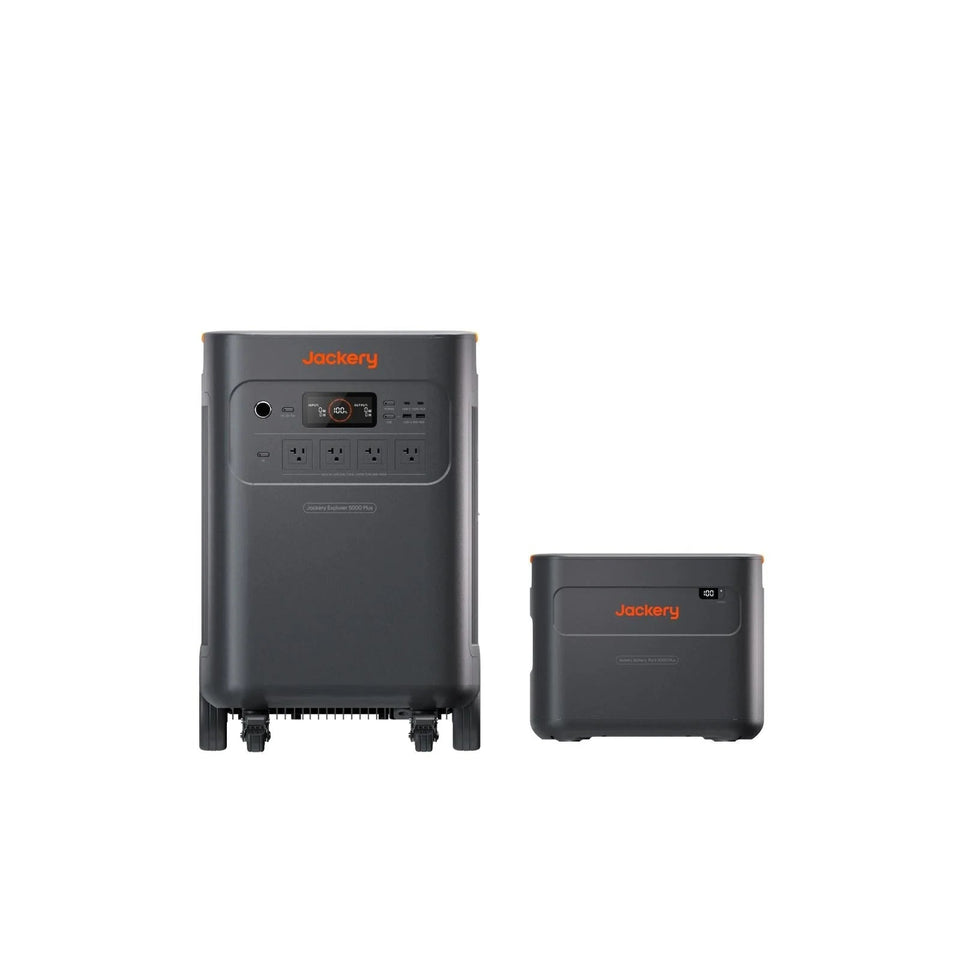
Jackery Explorer 5000 Plus
Combines a 5,040Wh LFP core, 7,200W split-phase output, 14,400W published surge headroom, and both High-PV (135–450V) and Low-PV solar inputs in a single wheeled chassis.
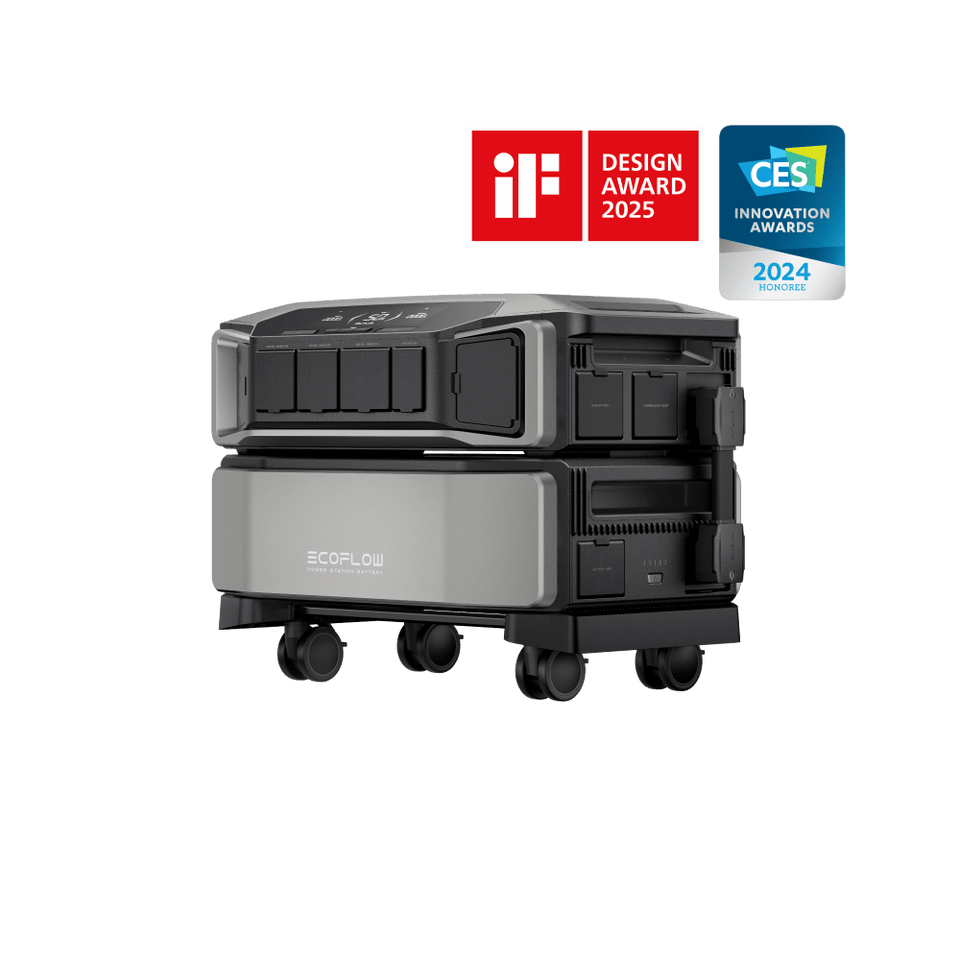
EcoFlow DELTA Pro Ultra
Built specifically for homeowners seeking high-voltage solar input (up to 5,600W) and modular 6kWh-per-stack scaling, though total kit cost and modular footprint exceed casual portable needs.
Frequently Asked Questions
What is the key difference between the original Anker SOLIX F3800 and the F3800 Plus?+
The original F3800 (Model A1790) caps solar input at 2,400W across two 11V–60V Voc ports and pairs a 14-50R with an L14-30R twist-lock port. The newer F3800 Plus revision expands solar tolerance to 11V–165V Voc (3,200W total solar input) and adjusts RV/transfer outlet hardware, making it much easier to connect higher-voltage solar strings.
Why did the Anker SOLIX F3800 finish behind smaller 2kWh units in CNET's refrigerator runtime test?+
CNET reported approximately 25.68 hours of standardized refrigerator runtime on the 3,840Wh F3800—shorter than the 2,048Wh BLUETTI AC200L (>29 hours). High-output 6,000W split-phase inverters inherently consume greater standby overhead while idle between refrigerator compressor cycles, reducing light-load net efficiency.
Can the Anker SOLIX F3800 charge while stored below freezing?+
No. Anker specifies a charging operating window of 32°F to 104°F (0°C to 40°C) without an automatic internal battery heater. Discharging is supported down to -4°F (-20°C), so winter recharging requires warming the station indoors first.
Sources & Technical References
- View Source →[1]Manufacturer SpecificationAnker SOLIX US OfficialVerified 2026-11-24Anker SOLIX F3800 Portable Power Station Official Specifications
North American model specs including NEMA 14-50R, L14-30R, 6,000W output, 3,840Wh capacity, and 11-60V dual solar input.
- View Source →[2]Manufacturer SpecificationAnker SOLIX US OfficialVerified 2026-11-24Anker SOLIX F3800 Plus Official Product Page
Successor revision increasing PV voltage range up to 165V and solar input to 3,200W.
- View Source →[3]Third-Party Independent ReviewCNETVerified 2026-11-24CNET Portable Power Station Lab Efficiency & Refrigerator Runtime Benchmarks
Documents standardized refrigerator runtime and round-trip efficiency testing including BLUETTI AC200L (77.76% RTE, >29h fridge test) and Anker SOLIX F3800 (~25.68h fridge stress runtime due to dual-voltage inverter overhead).
- View Source →[4]Technical & Safety StandardNational Fire Protection Association (NFPA)Verified 2026-11-24NFPA 70 National Electrical Code (NEC) Transfer Equipment & Standby Power Overview
Governs transfer switches, panel interlocks, and prohibition of unsafe backfeeding on US residential electrical panels.
Model & Brand Comparisons
Related Sizing Guides & Tools
- 120V vs. 240V Home Backup Explained: Split-Phase Circuits, Well Pumps & Transfer Safety →
- Transfer Equipment & Professional Installation: Safe Home Backup Integration →
- Understanding Power Station Efficiency: Why Rated Wh Never Equals Usable AC Energy →
- RV & Camper Van Power Station Compatibility Guide: TT-30R, Roof AC & 12V/48V DC →
- Calculate custom runtime for Anker SOLIX F3800 →