Jackery Explorer 5000 Plus vs. Anker SOLIX F3800 (2026): Single-Tower 240V Showdown
Compare Jackery Explorer 5000 Plus and Anker SOLIX F3800 at ~$2,999 street price: 5,040Wh vs 3,840Wh, 14,400W surge, 450V vs 60V solar, and UPS differences.
Trading around the same ~$2,999 typical US street price, the Jackery Explorer 5000 Plus and Anker SOLIX F3800 are the closest direct rivals in wheeled 240V backup. On paper, Jackery packs more base storage (5,040Wh vs 3,840Wh), higher continuous/surge ratings (7,200W/14,400W vs 6,000W/9,000W), 0 ms direct Online UPS, and High-PV 135–450V solar support (4,000W). Anker counters with 80% cycle retention rating (vs >=70% on Jackery), broader low-voltage solar tolerance (2,400W at 11–60V vs Jackery's 1,200W Low-PV limit), and wider street discounts.
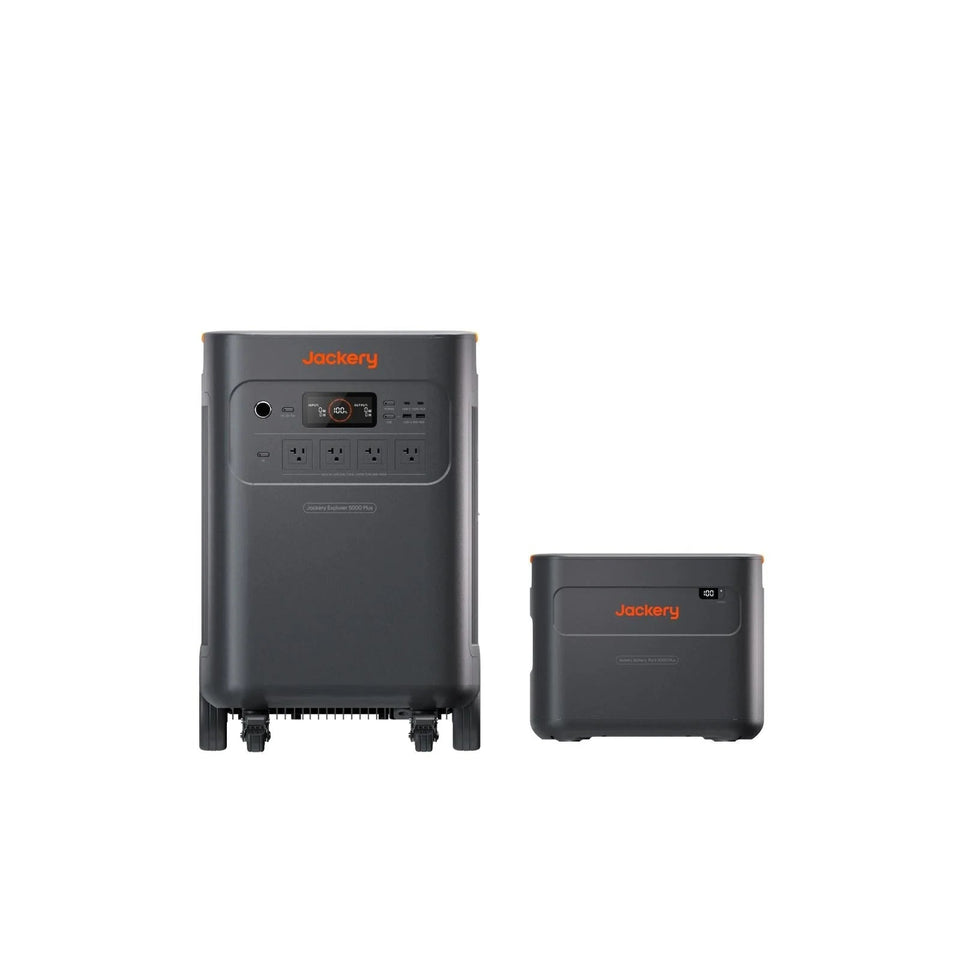

Technical Specifications Comparison
| Specification | Jackery Explorer 5000 Plus | Anker SOLIX F3800 |
|---|---|---|
| Hardware Visual | | |
| Battery Capacity | 5,040 Wh (LiFePO4 (LFP)) | 3,840 Wh (LiFePO4 (LFP)) |
| Continuous / Surge AC | 7,200W / 14,400W | 6,000W / 9,000W |
| AC Output Voltage | 120V / 240V Split-Phase | 120V / 240V Split-Phase |
| Solar Input & Voc | 4,000W (High-PV: 135V–450V Voc | Low-PV: 16V–60V Voc) | 2,400W (11V–60V Voc per dual XT60 port (Note: F3800 Plus expands to 11V–165V / 3,200W)) |
| Weight & Portability | 134.5 lbs — Wheeled single-chassis unit (~61 kg) with pull handle | 132.3 lbs — Single-chassis wheeled suitcase unit (~60 kg) with telescopic handle |
| 3rd-Party Usable AC Wh | Not Independently Verified | Not Independently Verified |
| Typical Street / $/Rated Wh | $2,999 ($0.60/Wh) | $2,999 ($0.78/Wh) |
Combines a 5,040Wh LFP core, 7,200W split-phase output, 14,400W published surge headroom, and both High-PV (135–450V) and Low-PV solar inputs in a single wheeled chassis.
One of the most approachable plug-and-play 120V/240V wheeled units thanks to built-in NEMA 14-50R and L14-30R ports, though high idle overhead on light loads and the 60V solar cap (on the original non-Plus SKU) require careful sizing.
Product Overview
With typical US street promotions placing both units near $2,999 ($3,499 MSRP on Jackery vs. $3,999 launch MSRP on Anker), the Jackery Explorer 5000 Plus and Anker SOLIX F3800 offer the closest head-to-head choice for homeowners seeking a single wheeled 120V/240V power station. Both weigh ~132–135 lbs, carry 5-year US warranties (with Jackery registration terms), and support expansion above 50kWh.
Key Differences
- Base Battery & Street Value (
5,040Whvs3,840Wh): Jackery includes 31% more base capacity (5,040Wh,~$0.60/rated Wh) than the original F3800 (3,840Wh,~$0.78/rated Wh) at similar street pricing, scaling up to60.48kWhacross two linked units versus53.76kWhon Anker. - Inverter Output & Published Surge (
7,200W/14,400Wvs6,000W/9,000W): Jackery provides higher continuous output (7,200Wvs.6,000W) and notably larger published surge headroom (14,400Wvs.9,000W), though exact surge millisecond duration is undisclosed on both spec sheets. - Solar Input Design (
High-PVvsLow-PV): Jackery targets rooftop/ground strings with4,000WHigh-PV (135V–450V Voc), while restricting low-voltage16V–60Vportable panels to1,200W. Conversely, the original Anker F3800 dedicates2,400W(2 × 1,200W) strictly to11V–60Vinputs (whereas Anker’s newerF3800 Plusadds11V–165V/3,200W). - UPS Switching Speed (
0 msvs<20 ms): Jackery provides0 msOnline UPS mode on direct unit outlets (and<20 msvia its Smart Transfer Switch), whereas the F3800 rates<20 msacross designated UPS bypass outlets.
Which Specifications Matter & Real-World Effects
- Cycle Retention Standards: Jackery specifies
4,000cycles to >=70% capacity, while Anker specifies3,000cycles to 80% capacity—making direct longevity comparisons closer than headline cycle numbers first suggest. - 240V AC Recharge Speed: When paired with Jackery’s Smart Transfer Switch (
240V), the Explorer 5000 Plus accepts up to4,000WAC recharging (~1.7 hrs), whereas the original F3800 limits standalone AC wall charging to1,800W(~2.7 hrs) unless paired with Anker’s Home Power Panel ecosystem. - Light-Load Overhead Caution: As CNET’s
~25.68-hourfridge test on the F3800 demonstrated, large6,000W–7,200Wdual-voltage inverters incur meaningful idle power consumption when powering small intermittent120Vloads alone.
Best Use Cases
- Jackery Explorer 5000 Plus fits: Homeowners wanting
5kWhbase capacity,14,400Wsurge headroom for well pumps or shop compressors (confirm LRA with an electrician),0 msdirect UPS, and future135–450Vrigid solar array expansion. - Anker SOLIX F3800 fits: Buyers recharging primarily from
11V–60Vportable folding panels (2,400Wcapacity), RV/EV owners already invested in Anker’s ecosystem, or shoppers finding deeper clearance markdowns below$2,999.
Advantages & Trade-offs
Even though Jackery posts higher numbers on capacity (5,040Wh), wattage (7,200W/14,400W), and High-PV voltage (450V), it limits low-voltage portable solar panels to 1,200W, rates cell aging to >=70% at 4,000 cycles, and relies on a 3+2 year registration warranty structure. Anker F3800 accepts double the low-voltage portable solar (2,400W), uses an 80% cycle-life benchmark, and maintains clean 5-year standard warranty language, while giving up High-PV (>60V) capability unless upgrading to the F3800 Plus.
Evidence Supporting the Conclusion
Manufacturer specifications from Jackery (5,040Wh, 135–450V High-PV, 0 ms direct UPS) and Anker SOLIX (3,840Wh, 11–60V dual XT60 on F3800, 80% retention at 3,000 cycles) establish the technical trade-offs, while CNET’s fridge test underscores idle draw in the 240V class. Neither system should be hardwired to home circuits without listed transfer gear and a licensed electrician following NFPA 70 / NEC requirements.
Final Decision Matrix
- You want 5,040Wh capacity, 7,200W continuous / 14,400W surge, and 0 ms Online UPS around $2,999 street
- You want native High-PV (135V–450V, 4,000W) solar array compatibility without stepping up to a modular stack
- You need 4,000W AC recharging via a compatible 240V Smart Transfer Switch
- You rely on multiple low-voltage portable solar panels (F3800 takes 2,400W at 11–60V vs 1,200W Low-PV on Jackery)
- You prefer LFP cycle life specified to 80% retention (3,000 cycles) rather than Jackery's >=70% at 4,000 cycles
- You already own or prefer Anker's BP3800 / Home Power Panel ecosystem or upgrade to the F3800 Plus
Frequently Asked Questions
Which weighs more: the Jackery Explorer 5000 Plus or Anker SOLIX F3800?+
They are virtually identical in chassis weight: 134.5 lbs for the Jackery Explorer 5000 Plus vs 132.3 lbs for the Anker SOLIX F3800. Both roll on integrated wheels for flat floors and typically require two people for lifting into vehicles.
Do both models include NEMA 14-50 and L14-30 240V outlets?+
Yes. Both the Jackery Explorer 5000 Plus and the original Anker SOLIX F3800 include a 120V/240V NEMA 14-50 receptacle and a twist-lock NEMA L14-30R outlet directly on the main unit.
Why does Jackery specify 4,000W High-PV and 1,200W Low-PV solar separately?+
Jackery uses a dual-voltage solar architecture: rigid high-voltage strings (135V–450V Voc) feed the High-PV input up to 4,000W, whereas low-voltage portable panels (16V–60V Voc) feed two Low-PV ports capped at 600W each (1,200W total). The original Anker F3800 gives all 2,400W to low-voltage 11–60V ports.
Sources & Technical References
- View Source →[1]Manufacturer SpecificationJackery US OfficialVerified 2026-11-24Jackery Explorer 5000 Plus Official Product Specifications
5,040Wh LFP capacity, 7,200W/14,400W AC specs, High-PV (135-450V) and Low-PV (16-60V) limits, and warranty terms.
- View Source →[2]Manufacturer SpecificationAnker SOLIX US OfficialVerified 2026-11-24Anker SOLIX F3800 Portable Power Station Official Specifications
North American model specs including NEMA 14-50R, L14-30R, 6,000W output, 3,840Wh capacity, and 11-60V dual solar input.
- View Source →[3]Manufacturer SpecificationAnker SOLIX US OfficialVerified 2026-11-24Anker SOLIX F3800 Plus Official Product Page
Successor revision increasing PV voltage range up to 165V and solar input to 3,200W.
- View Source →[4]Third-Party Independent ReviewCNETVerified 2026-11-24CNET Portable Power Station Lab Efficiency & Refrigerator Runtime Benchmarks
Documents standardized refrigerator runtime and round-trip efficiency testing including BLUETTI AC200L (77.76% RTE, >29h fridge test) and Anker SOLIX F3800 (~25.68h fridge stress runtime due to dual-voltage inverter overhead).
- View Source →[5]Technical & Safety StandardNational Fire Protection Association (NFPA)Verified 2026-11-24NFPA 70 National Electrical Code (NEC) Transfer Equipment & Standby Power Overview
Governs transfer switches, panel interlocks, and prohibition of unsafe backfeeding on US residential electrical panels.