120V vs. 240V Home Backup Explained: Split-Phase Circuits, Well Pumps & Transfer Safety
Understand how US 120V/240V split-phase residential power works conceptually, which home appliances need 240V vs. 120V, and why transfer hardware and licensed installation matter.
US homes use 120V/240V split-phase power: standard outlets, refrigerators, routers, and gas furnace blowers use 120V circuits, whereas heavy loads like submersible well pumps, electric dryers, and central AC compressors require native 240V split-phase across both hot legs. Connecting either 120V or 240V backup hardware to residential circuits requires NEC-compliant transfer equipment installed by a licensed electrician.

Key Technical Takeaways
- Standard US homes use 120V/240V split-phase service: normal wall outlets use one 120V leg, whereas heavy appliances like well pumps, dryers, and central AC require 240V across both opposite legs.
- A 120V-only power station (e.g., BLUETTI AC200L or Jackery 2000 v2) cannot run 240V double-pole appliances even if its total wattage looks sufficient.
- Connecting any 120V or 240V backup battery to home circuits requires NEC-compliant transfer equipment installed by a licensed electrician—never DIY backfeeding.
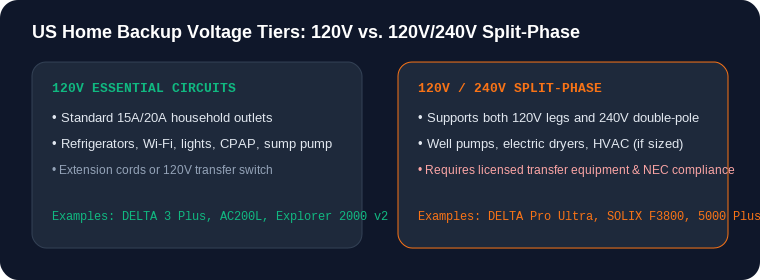
One of the biggest sources of buyer confusion in emergency power is assuming that “more watts” automatically equals “whole-house backup.” In North America, voltage architecture matters just as much as wattage. A 2,400W 120V portable power station and a 7,200W 120V/240V split-phase system do not simply differ in capacity—they interact with fundamentally different parts of your home’s electrical system.
How US Residential Split-Phase Power Works (Conceptually)
Standard US residential electrical service is 120V / 240V split-phase alternating current:
- Two Hot Legs (L1 and L2) + Neutral: Utility transformers deliver two 120V legs that are 180 degrees out of phase relative to the neutral wire.
- 120V Circuits (Single-Pole Breakers): Standard wall outlets, ceiling lights, refrigerators, and microwaves connect between either Leg 1 or Leg 2 and Neutral, receiving 120V.
- 240V Circuits (Double-Pole Breakers): Heavy appliances connect across both Leg 1 and Leg 2 (
120V + 120V = 240V) using linked two-pole circuit breakers.
Because a 120V-only power station produces only a single 120V hot leg, it cannot power 240V double-pole equipment—no matter how high its wattage rating climbs.
Which Home Appliances Are 120V vs. 240V?
Before shopping, walk through your essential outage needs conceptually (and confirm actual circuit labels with a licensed electrician):
| Voltage Tier | Common Residential Loads | Typical Backup Approach |
|---|---|---|
| 120V Essential Loads | Standard kitchen refrigerator, chest freezer, Wi-Fi router/modem, LED lights, CPAP, laptop workstation, 120V sump pump, microwave, coffee maker | Powered directly via heavy-gauge indoor extension cords (for standalone plug-in items) OR via a licensed 120V manual transfer switch. |
| 240V Split-Phase Loads | Submersible well pump (e.g., 1 HP ~1,800W run / ~4,800W startup), central HVAC air conditioner / heat pump, electric water heater, electric dryer, electric range/oven | Requires a native 120V/240V split-phase inverter system + NEC-compliant 240V transfer switch, interlock, or smart home panel installed by a licensed electrician. |
Important Multi-Wire Branch Circuit (MWBC) Caveat: Some older or kitchen US home circuits share a single neutral wire across two opposite 120V legs. Feeding both legs of a shared-neutral circuit from the same 120V phase—which improper single-phase bridging can cause—risks overloading the shared neutral wire. That is one reason professional panel evaluation by a licensed electrician is mandatory before energizing any home circuit.
Comparing 120V-Only vs. 120V/240V Models in Our Database
120V-Only Midsize Stations (Essential Circuit Focus)
Models like the BLUETTI AC200L (2,048Wh / 2,400W), Jackery Explorer 2000 v2 (2,042Wh / 2,200W), Pecron E1500LFP (1,536Wh / 2,200W), and EcoFlow DELTA 3 Plus (1,024Wh / 1,800W) are built strictly for 120V power. They shine for plug-in refrigerators, freezers, internet gear, lights, and small heating/cooking bursts without the cost, weight, or higher idle draw of 240V split-phase inverters.
Native 120V/240V Split-Phase Systems
Four units in our verified database deliver true simultaneous 120V/240V output from a single system:
- EcoFlow DELTA Pro Ultra: 6,144Wh base (expandable to 90kWh across 3 units), 7,200W continuous / 10,800W surge, NEMA L14-30R + L6-30R/Smart Home Panel 2 interface.
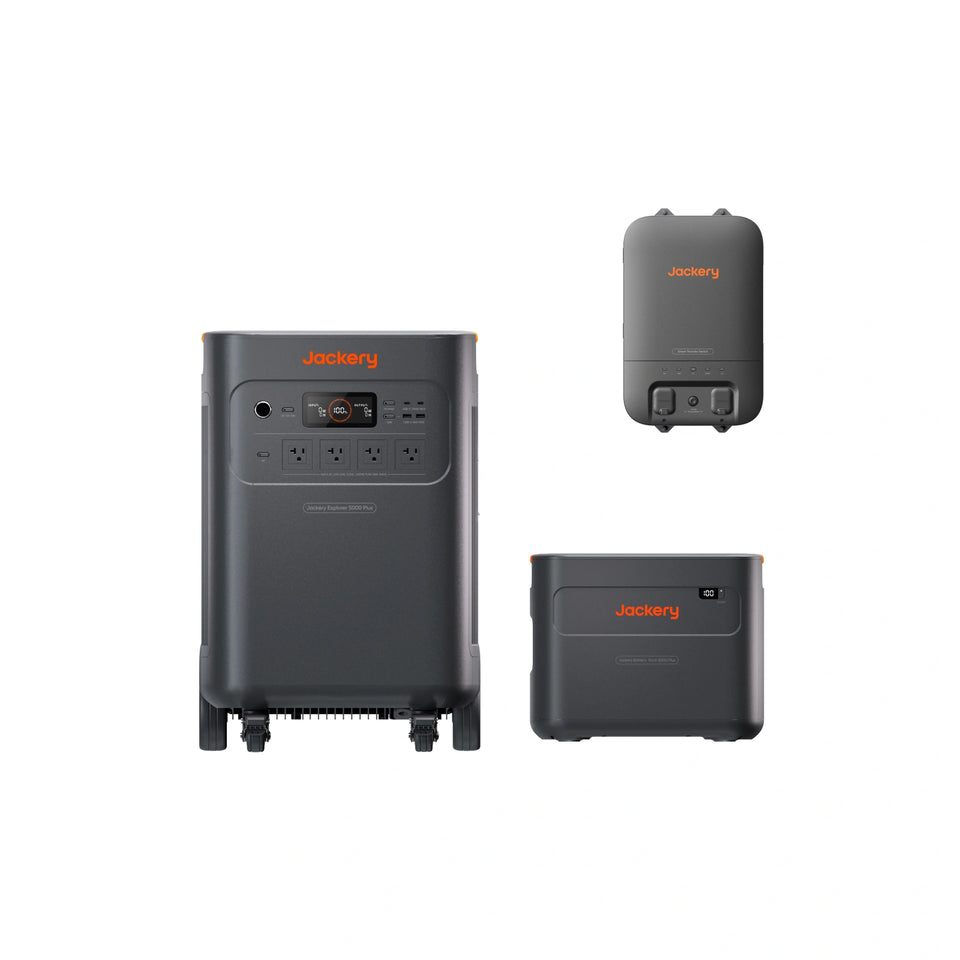
- Jackery Explorer 5000 Plus: 5,040Wh base (expandable to 60.48kWh), 7,200W continuous / 14,400W surge, NEMA L14-30R + NEMA 14-50 outlets + Jackery Smart Transfer Switch compatibility.
- Anker SOLIX F3800: 3,840Wh base (expandable to 53.76kWh), 6,000W continuous / 9,000W surge, built-in NEMA 14-50R + NEMA L14-30R + Anker Home Power Panel integration.
- Zendure SuperBase V4600: 4,608Wh base (expandable to 46.08kWh), 3,800W continuous / 7,600W surge (7,600W continuous with two units linked), dual-voltage terminal + TT-30R.
Critical Safety Principles: Always Use Listed Transfer Equipment & Licensed Electricians
Safety Notice: Connecting any portable power station or whole-home battery to residential building wiring must comply with NFPA 70 (National Electrical Code / NEC) and local Authority Having Jurisdiction (AHJ) permitting rules.
- Never Improvise Backfeed Cords: Using a double-ended male plug (“suicide cord”) into a dryer or wall outlet is extremely dangerous and illegal—it creates exposed live prongs and can energize outside utility lines, endangering lineworkers and causing fire or electrocution hazards.
- Professional Panel Integration Only: We do not provide DIY breaker-panel wiring tutorials. Always hire a licensed electrician to evaluate your main service panel, verify neutral-ground bonding rules per the manufacturer’s manual and NEC, and install a listed transfer switch, mechanical interlock kit, or smart home panel.
- No System Is Risk-Free: Even properly permitted residential battery backup systems require adherence to manufacturer clearance, ventilation, temperature, and overcurrent limits.
Next, read our conceptual overview of safe integration hardware in Transfer Equipment & Professional Installation, or size your critical circuits with our Appliance Wattage Calculator.
Frequently Asked Questions
Can a 2,400W 120V power station power a 240V well pump using an adapter cord?+
No. A 120V-only inverter outputs only a single 120V phase; no passive adapter cord can create true 240V split-phase power. Furthermore, running a 240V submersible well pump requires true 120V/240V split-phase hardware (such as the EcoFlow DELTA Pro Ultra, Jackery Explorer 5000 Plus, or Anker SOLIX F3800), ample locked-rotor startup surge capacity, and licensed transfer integration.
Do I really need a 240V power station if I only want to back up my fridge, Wi-Fi, lights, and gas furnace?+
Not necessarily. Refrigerators, routers, LED lighting, CPAP units, and most residential natural-gas or propane furnace blowers operate on 120V circuits. However, integrating a hardwired gas furnace or kitchen circuits into a home panel still requires listed transfer equipment and a licensed electrician, and multi-wire branch circuits (MWBC) require special 240V split-phase awareness.
Can a single 7,200W 240V power station run my entire house including central AC and an electric stove?+
Rarely all at once without load management. A typical 3-ton central AC unit, electric water heater, and electric range can easily exceed 7,200W continuous and 10,000W+ startup surges—and drain a 5kWh–6kWh battery in an hour or two. Whole-home backup typically focuses on prioritized critical circuits or requires multiple parallel inverters and large battery stacks.
Sources & Technical References
- View Source →[1]Technical & Safety StandardNational Fire Protection Association (NFPA)Verified 2026-11-24NFPA 70 National Electrical Code (NEC) Transfer Equipment & Standby Power Overview
Governs transfer switches, panel interlocks, and prohibition of unsafe backfeeding on US residential electrical panels.
- View Source →[2]Manufacturer SpecificationEcoFlow US OfficialVerified 2026-11-24EcoFlow DELTA Pro Ultra Product Page & Specifications
Official North American 120V/240V split-phase inverter and 6,144Wh LiFePO4 battery module specs.
- View Source →[3]Manufacturer SpecificationAnker SOLIX US OfficialVerified 2026-11-24Anker SOLIX F3800 Portable Power Station Official Specifications
North American model specs including NEMA 14-50R, L14-30R, 6,000W output, 3,840Wh capacity, and 11-60V dual solar input.
- View Source →[4]Manufacturer SpecificationJackery US OfficialVerified 2026-11-24Jackery Explorer 5000 Plus Official Product Specifications
5,040Wh LFP capacity, 7,200W/14,400W AC specs, High-PV (135-450V) and Low-PV (16-60V) limits, and warranty terms.
- View Source →[5]Manufacturer SpecificationZendure US OfficialVerified 2026-11-24Zendure SuperBase V4600 Product Overview & Specifications
4,608Wh LFP model specs, 3,800W continuous dual-voltage output, 3,000W solar input (12-150V), and 3-year US limited warranty.
- View Source →[6]Manufacturer SpecificationBLUETTI US OfficialVerified 2026-11-24BLUETTI AC200L Portable Power Station Official Specifications
2,048Wh LFP, 2,400W continuous AC, 3,600W Power Lifting mode, NEMA TT-30R + 48V/8A DC RV port, 1,200W solar (12-145V).