Jackery Explorer 5000 Plus Review (2026): 7,200W Split-Phase Output & 14.4kW Surge Ceiling
Jackery Explorer 5000 Plus US review: 5,040Wh LFP capacity, 7,200W 120V/240V inverter, 14,400W surge rating, High-PV 4,000W input, and trade-offs.
The Jackery Explorer 5000 Plus packs a 5,040Wh LiFePO4 core, 7,200W continuous split-phase inverter, 14,400W surge rating, and dual High-PV/Low-PV solar architecture into a single wheeled chassis priced aggressively near $2,999 on the street. Trade-offs include its 134.5 lb indivisible body weight, a 1,200W Low-PV portable solar ceiling, and cycle longevity rated to >=70% capacity rather than 80%, alongside unverified third-party usable AC Wh benchmarks.
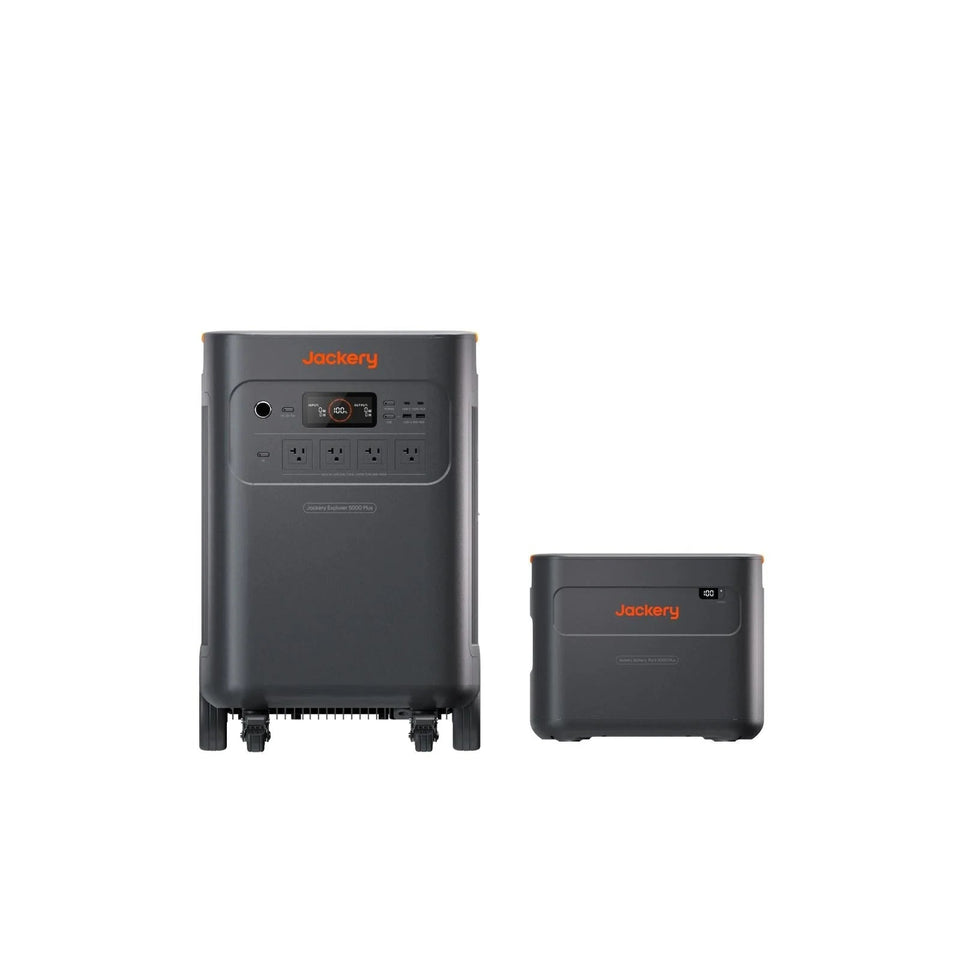
Standalone Explorer 5000 Plus lists at $3,499 MSRP; seasonal US discounts commonly range $2,849–$3,299 ($0.60/rated Wh at street pricing).
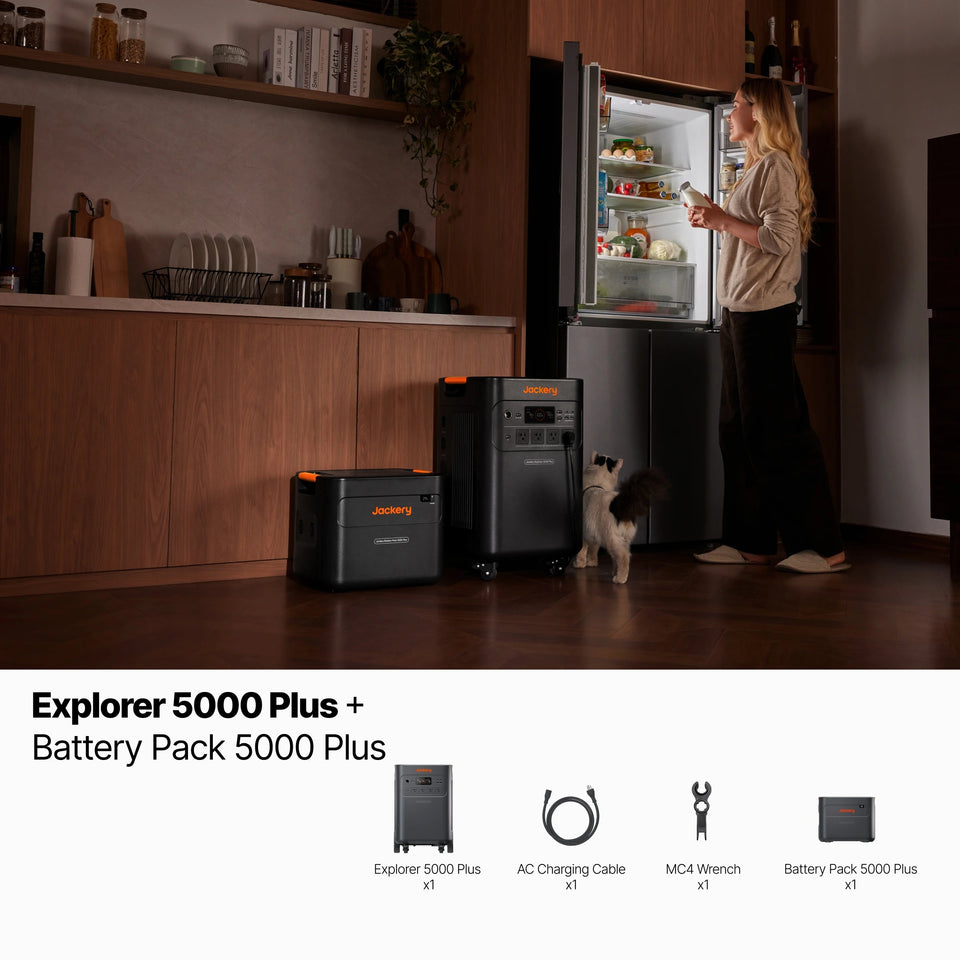
Official Hardware & Application Gallery
Sourced from Jackery official product media 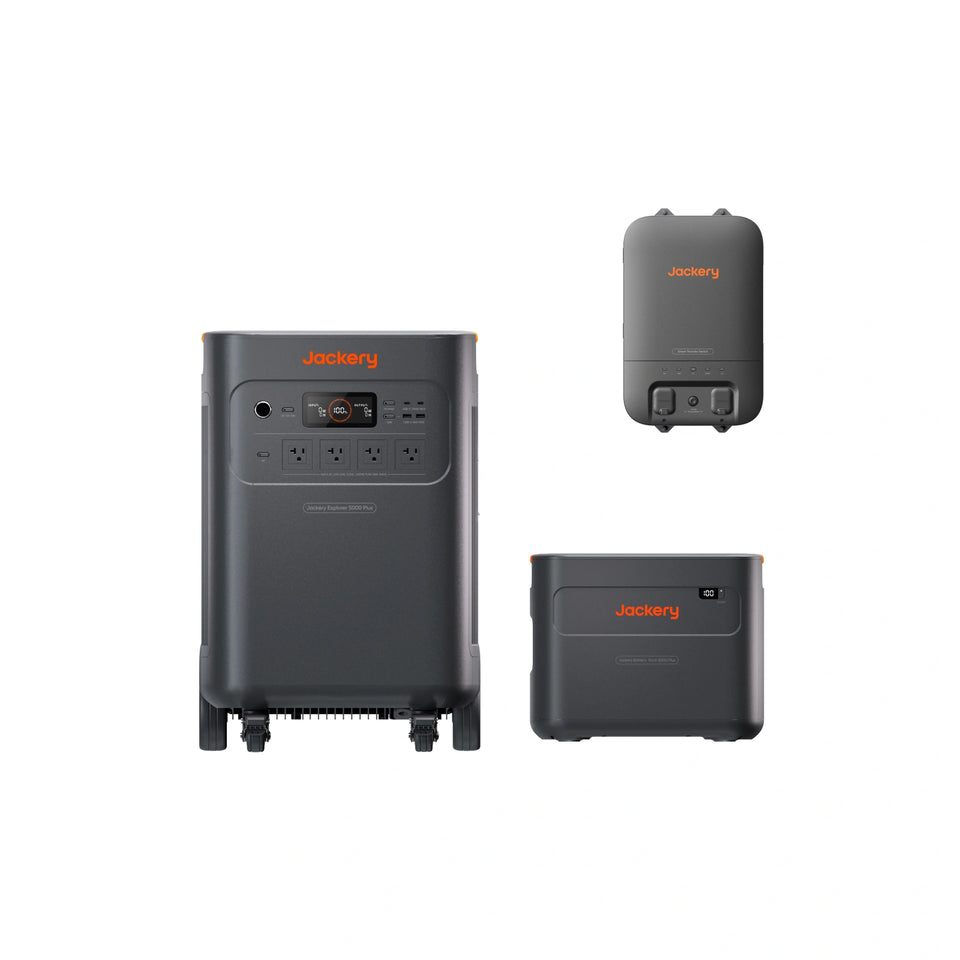
Key Advantages
- ✓High 14,400W published surge ceiling helps accommodate inductive startup spikes when properly sized
- ✓Supports both high-voltage array strings (135–450V) and portable 16–60V solar panels
- ✓0 ms Online UPS mode on supported direct outlets plus <20 ms Smart Transfer Switch compatibility
Trade-offs & Limitations
- !134.5 lb single-body weight is less modular to carry up/down stairs than EcoFlow's split stack
- !Low-voltage solar input tops out at 1,200W (600W per port) unless using the High-PV input
- !Cycle life is specified to >=70% retention at 4,000 cycles rather than 80% used by some peers
Ideal Applications
- Homeowners wanting 5kWh+ and 7,200W 240V output in one wheeled tower
- Users planning future integration with high-voltage solar arrays and a Smart Transfer Switch
Situations Where It May Not Fit
- Frequent solo vehicle loading without ramps
- Off-grid setups relying strictly on >1,200W of low-voltage portable solar panels
Complete Verified Specifications
| Specification | Verified Data | Data Provenance |
|---|---|---|
| Product Name & Revision | Jackery Explorer 5000 Plus (1st Gen Whole-Home Plus Series) | Manufacturer Spec |
| US Market Version | US 120V/240V Edition | Manufacturer Spec |
| Battery Capacity (Rated) | 5,040 Wh | Manufacturer Spec |
| Measured Usable AC Output | Not Independently Verified | Unverified |
| Battery Chemistry | LiFePO4 (LFP) | Manufacturer Spec |
| Published Cycle Life | 4,000 cycles to >=70% original capacity — Manufacturer specification under standard lab cycling conditions | Manufacturer Spec |
| Continuous AC Output | 7,200 W (Not Applicable (native 7,200W continuous dual-voltage output)) | Manufacturer Spec |
| Published Surge Output | 14,400 W | Manufacturer Spec |
| Published Surge Duration | Not Disclosed (duration not published in primary specification summary) | Not Disclosed |
| AC Output Voltage | 120V / 240V Split-Phase | Manufacturer Spec |
| AC Outlet Types | 4 × 120V 20A NEMA 5-20 outlets; 1 × 120V/240V NEMA L14-30R twist-lock (30A); 1 × 120V/240V NEMA 14-50 outlet (up to 7,200W output) | Manufacturer Spec |
| USB-A Output | 2 × USB-A (18W max each) | Manufacturer Spec |
| USB-C Output | 2 × USB-C (100W max each) | Manufacturer Spec |
| DC Output Ports | 1 × 12V/10A Car Port (120W max) | Manufacturer Spec |
| Max Solar Input | 4,000 W | Manufacturer Spec |
| Solar Input Voltage Range (Voc) | High-PV: 135V–450V Voc | Low-PV: 16V–60V Voc | Manufacturer Spec |
| Solar Input Current Limit | High-PV: 15A | Low-PV: 10.5A single / 21A dual | Manufacturer Spec |
| MPPT Configuration | Dual-voltage PV architecture (4,000W High-PV + up to 1,200W Low-PV) | Manufacturer Spec |
| AC Charging Rate | 4,000 W max — Up to ~1,750W–1,800W via 120V wall outlet (~3.5 hrs); up to 4,000W AC via 240V Smart Transfer Switch (~1.7 hrs) | Manufacturer Spec |
| Car / Alternator Charging | 12V car charging supported via DC input cable | Manufacturer Spec |
| Published Recharge Time | Approx. 3.5 hrs on 120V wall outlet; ~1.7 hrs via 240V STS or hybrid 4,000W High-PV solar | Mfr / Attributed Test |
| Expandable Capacity | Yes — up to 60,480 Wh (Up to 30,240Wh with 5 × Battery Pack 5000 Plus per unit; up to 60kWh with two units linked) | Manufacturer Spec |
| Supported Expansion Batteries | Jackery Battery Pack 5000 Plus (5,040Wh) | Manufacturer Spec |
| UPS / EPS Functionality | 0 ms Online UPS mode on direct outlets; <20 ms automatic switchover via Jackery Smart Transfer Switch | Manufacturer Spec |
| Published Switching Time | 0 ms Online UPS (direct) / <20 ms Transfer Switch | Manufacturer Spec |
| Weight | 134.5 lbs (Wheeled single-chassis unit (~61 kg) with pull handle) | Manufacturer Spec |
| Dimensions (L × W × H) | 25.0 × 15.5 × 16.5 in | Manufacturer Spec |
| Operating Temp (Charging) | 32°F to 113°F (0°C to 45°C) | Manufacturer Spec |
| Operating Temp (Discharging) | 5°F to 113°F (-15°C to 45°C) | Manufacturer Spec |
| Noise Rating (Manufacturer) | ~30 dB in quiet charging mode (manufacturer rated) | Manufacturer Spec |
| App & Connectivity | Wi-Fi & Bluetooth via Jackery App | Manufacturer Spec |
| Warranty & Verification Date | 5-Year Warranty (3-year standard + 2-year automatic/registered extension per US terms) (Verified 2026-11-24) | Manufacturer Policy |
| Pricing & Value per Rated Wh | Typical Street ~$2,999 ($0.60/rated Wh) | MSRP $3,499 ($0.69/rated Wh) | Checked 2026-11-24 |
Evidence & Data Provenance Breakdown
SolarGeneratorWholeHouse separates official specifications, third-party measurements, owner patterns, and editorial estimates.
Capacity (5,040Wh LiFePO4 (LFP)), continuous AC (7,200W), surge (14,400W), solar voltage limits (High-PV: 135V–450V Voc | Low-PV: 16V–60V Voc), and warranty (5-Year Warranty (3-year standard + 2-year automatic/registered extension per US terms)) are sourced directly from Jackery documentation.
Not Independently Verified in Our Source Registry: Independent laboratory usable-AC-Wh discharge benchmarks for this exact US SKU are not yet recorded in our verified registry; runtime figures below use clearly labeled engineering estimates.
Noise (~30 dB in quiet charging mode (manufacturer rated)) and cycle retention (4,000 cycles to >=70% original capacity) reflect Jackery's published ratings under manufacturer-specified test temperatures rather than independent long-term wear tests.
Early buyers appreciate the aggressive street pricing per Wh compared to 6kWh modular kits and the inclusion of both 14-50 and L14-30 outlets on the main chassis.
Unpublished fields: Surge duration (Not Disclosed (duration not published in primary specification summary)).
Estimated AC Runtime Scenarios
| Sample Load | Estimated Runtime Range | Calculation Basis |
|---|---|---|
| Wi-Fi Router & Modem (~25W AC) | 157.2–177.4 hrs | Estimated 78%–88% usable AC range (untested model; accounts for inverter conversion & idle draw) |
| CPAP Machine (~45W AC avg) | 87.4–98.6 hrs | Estimated 78%–88% usable AC range (untested model; accounts for inverter conversion & idle draw) |
| Modern Refrigerator Avg Draw (~150W) | 26.2–29.6 hrs | Estimated 78%–88% usable AC range (untested model; accounts for inverter conversion & idle draw) |
| Home Office / Mixed Essential Load (~400W) | 9.8–11.1 hrs | Estimated 78%–88% usable AC range (untested model; accounts for inverter conversion & idle draw) |
| Portable AC / Heavy Load (~1,200W) | 3.3–3.7 hrs | Estimated 78%–88% usable AC range (untested model; accounts for inverter conversion & idle draw) |
Overview & US Market Positioning
With the Jackery Explorer 5000 Plus (US 120V/240V Edition), Jackery stepped squarely into whole-home split-phase backup territory to challenge both the EcoFlow DELTA Pro Ultra and the Anker SOLIX F3800. Rather than copying EcoFlow’s modular split inverter-and-battery stack, Jackery adopted a vertical wheeled single-tower format containing 5,040Wh of storage and a 7,200W split-phase inverter at 134.5 lbs.
Positioned aggressively at $3,499 MSRP and frequently discounted around $2,849–$3,299 (averaging ~$2,999 street), the Explorer 5000 Plus significantly undercuts EcoFlow’s starter kit on upfront price per watt-hour while delivering 1,200W more continuous AC power and 31% more base battery storage than the similarly priced original Anker F3800. You can examine the direct matchup in our Jackery Explorer 5000 Plus vs. Anker SOLIX F3800 comparison and EcoFlow vs. Jackery ecosystem comparison.
Battery Capacity, Chemistry & Cycle Longevity
The Explorer 5000 Plus houses a 5,040Wh LiFePO4 (LFP) battery pack. One subtle specification difference worth noting is Jackery’s retention benchmark: 4,000 cycles to >=70% original capacity, whereas EcoFlow (3,500+ cycles), Anker (3,000 cycles), and Zendure (3,000 cycles) specify their cycle life to 80% remaining capacity. Because capacity fade slows nonlinearly in LFP cells, 4,000 cycles to 70% is roughly comparable in real-world longevity to 3,000–3,500 cycles to 80%, though shoppers comparing spec sheets side by side should recognize the differing threshold.
Temperature limits follow standard unheated LFP norms: charging operates from 32°F to 113°F (0°C to 45°C), and discharging extends from 5°F to 113°F (-15°C to 45°C). Notice that unlike EcoFlow’s -4°F self-heating battery stack or Anker/Zendure’s -4°F discharge rating, Jackery sets its minimum discharge temperature at 5°F (-15°C) and lacks internal self-heating for sub-freezing charging—an important consideration for unheated garages in extreme northern states.
Continuous AC Output, Surge Behavior & Voltage Support
On paper, the Explorer 5000 Plus delivers impressive dual-voltage capability from a single chassis: 7,200W continuous 120V/240V split-phase AC paired with a headline 14,400W surge rating (though published surge duration is Not Disclosed in primary summary sheets). That 2× surge multiplier gives the Explorer 5000 Plus substantially more published inductive headroom than the Anker SOLIX F3800 (9,000W surge) or Zendure SuperBase V4600 (7,600W surge) when sizing well pumps, sump pumps, or air-conditioning compressors—always checking actual appliance nameplate LRA ratings first via our continuous vs. surge output guide.
Front and side AC connectivity covers most North American emergency needs cleanly:
- 4 × 120V 20A NEMA 5-20 outlets
- 1 × 120V/240V 30A NEMA L14-30R twist-lock port
- 1 × 120V/240V NEMA 14-50 outlet (up to 7,200W output)
USB and DC ports include two 100W USB-C outputs, two 18W USB-A ports, and a 12V/10A (120W) car port. Notice there is no dedicated 120V 30A NEMA TT-30R RV outlet (standard RVs using a 30A shore plug require an appropriate L14-30 or adapter strategy, unlike the Zendure SuperBase V4600 or BLUETTI AC200L). Any permanent connection to home circuits through the Jackery Smart Transfer Switch or a manual inlet requires listed transfer equipment installed by a licensed electrician in accordance with NEC/NFPA 70.
Solar Charging, AC Charging & Expansion Ecosystem
Jackery engineered a dual-voltage solar architecture capable of up to 4,000W max combined input, bridging both rigid residential panels and portable camp panels:
- High-PV Input: 135V–450V Voc, 15A max (up to 4,000W)
- Low-PV Input: 16V–60V Voc, 10.5A single / 21A dual (up to 1,200W total, 600W per port)
This split design avoids the 60V dead-end of the original Anker SOLIX F3800 while keeping portable panel compatibility open via the 16V–60V inputs. However, shoppers using purely portable low-voltage panels hit a 1,200W solar ceiling—meaning off-grid recovery of the 5,040Wh pack with portable folding panels takes significantly longer than with 4,000W high-voltage arrays. See our solar input limits and MPPT guide and Solar Charging Time Estimator for regional sun-hour calculations.
AC charging runs up to ~1,750W–1,800W on a standard 120V outlet (~3.5 hours full charge) or scales up to 4,000W AC (~1.7 hours) when fed 240V through the Jackery Smart Transfer Switch. Expansion relies on Jackery Battery Pack 5000 Plus (5,040Wh) add-ons—supporting up to five expansion packs per inverter (30,240Wh) or linking two Explorer 5000 Plus units up to 60,480Wh (60.48kWh) total.
UPS/EPS Behavior, Cooling Noise & App Features
A standout technical spec is 0 ms Online UPS mode on direct AC outlets alongside under-20 ms automatic switchover when wired through the Jackery Smart Transfer Switch. That dual capability puts Jackery on par with EcoFlow’s DELTA Pro Ultra for protecting desktop workstations, NAS arrays, and routers against sudden power flickers—with the same general caveat that active Online UPS operation draws continuous inverter idle power from the system.
Jackery rates acoustic output at ~30 dB in quiet charging mode, though full-load decibel figures under 7,200W discharge are Not Disclosed in primary datasheets and remain unverified in our independent lab registry. Connectivity includes Wi-Fi and Bluetooth via the Jackery App for charge-mode scheduling, battery health monitoring, and Smart Transfer Switch control.
Runtime Considerations & Real-World Performance Data
Independent third-party usable AC watt-hour tests and standardized round-trip efficiency measurements for the Explorer 5000 Plus are Not Independently Verified in our source registry. Using our standard 78% to 88% AC conversion estimate across the 5,040Wh battery (3,931Wh to 4,435Wh estimated usable AC energy):
- Wi-Fi Router & Modem (~25W AC): Approx. 157.2 to 177.4 hours theoretically (real-world duration may fall below this range due to 7,200W dual-voltage inverter idle draw at minimal loads).
- CPAP Machine (~45W AC): Approx. 87.4 to 98.6 hours.
- Modern Refrigerator (~150W avg): Approx. 26.2 to 29.6 hours.
- Home Office / Mixed Essential Load (~400W): Approx. 9.8 to 11.1 hours.
- Portable AC / Space Heating (~1,200W): Approx. 3.3 to 3.7 hours.
Model custom circuit durations with our Battery Runtime Estimator and audit your exact home startup requirements with the Appliance Wattage Calculator.
Build Quality, Portability & Dimensions
Measuring 25.0 × 15.5 × 16.5 inches and weighing 134.5 lbs, the Explorer 5000 Plus sits in a compact upright tower footprint on caster wheels with an integrated pull handle. Its footprint takes up slightly less floor length than the Anker F3800 (27.6 inches long) and avoids multi-box cabling for a standalone 5kWh setup. Still, at 134.5 lbs, it is strictly rollable on flat floors—lifting it over porch steps or into a truck bed requires two adults or loading ramps.
Advantages, Disadvantages & Ideal Applications
Key Advantages
- Strong 5,040Wh base capacity + 7,200W continuous / 14,400W surge split-phase inverter in one unit.
- Both 135V–450V High-PV (4,000W) and 16V–60V Low-PV (1,200W) solar inputs accommodate residential strings and portable panels.
- 0 ms Online UPS on direct outlets plus <20 ms Smart Transfer Switch automation at a sharp $2,999 typical street price.
Trade-offs & Limitations
- 134.5 lb single-chassis weight is harder to carry up stairs than EcoFlow’s separable 70 lb / 111.8 lb modules.
- Low-voltage portable solar input caps at 1,200W unless stepping up into the 135V–450V High-PV input.
- No internal self-heating for sub-freezing charging; 4,000-cycle rating is stated to >=70% retention rather than 80%, and third-party lab Wh tests are Not Independently Verified.
Ideal Applications: Budget-conscious homeowners seeking 5kWh+ and 7,200W 240V split-phase capacity in a single tower under $3,200, and households planning future Smart Transfer Switch and high-voltage solar expansion.
Price, Value per Rated Wh & Warranty
At $3,499 MSRP, the Explorer 5000 Plus enters at $0.69 per rated Wh, dropping to an exceptional $0.60 per rated Wh at its common $2,999 street price (and ~$0.57/Wh during $2,849 promotions). That makes it the lowest upfront cost per rated Wh among our verified 240V whole-home power stations—roughly 20% to 23% less per rated Wh at street pricing than both the EcoFlow DELTA Pro Ultra ($0.75/rated Wh) and Anker SOLIX F3800 ($0.78/rated Wh). Because third-party usable AC Wh figures are Not Independently Verified, exact cost per usable Wh remains an estimate. Jackery backs the US model with a 5-Year Warranty (3-year standard plus 2-year automatic/registered extension per US policy terms).
Close Alternatives to Consider
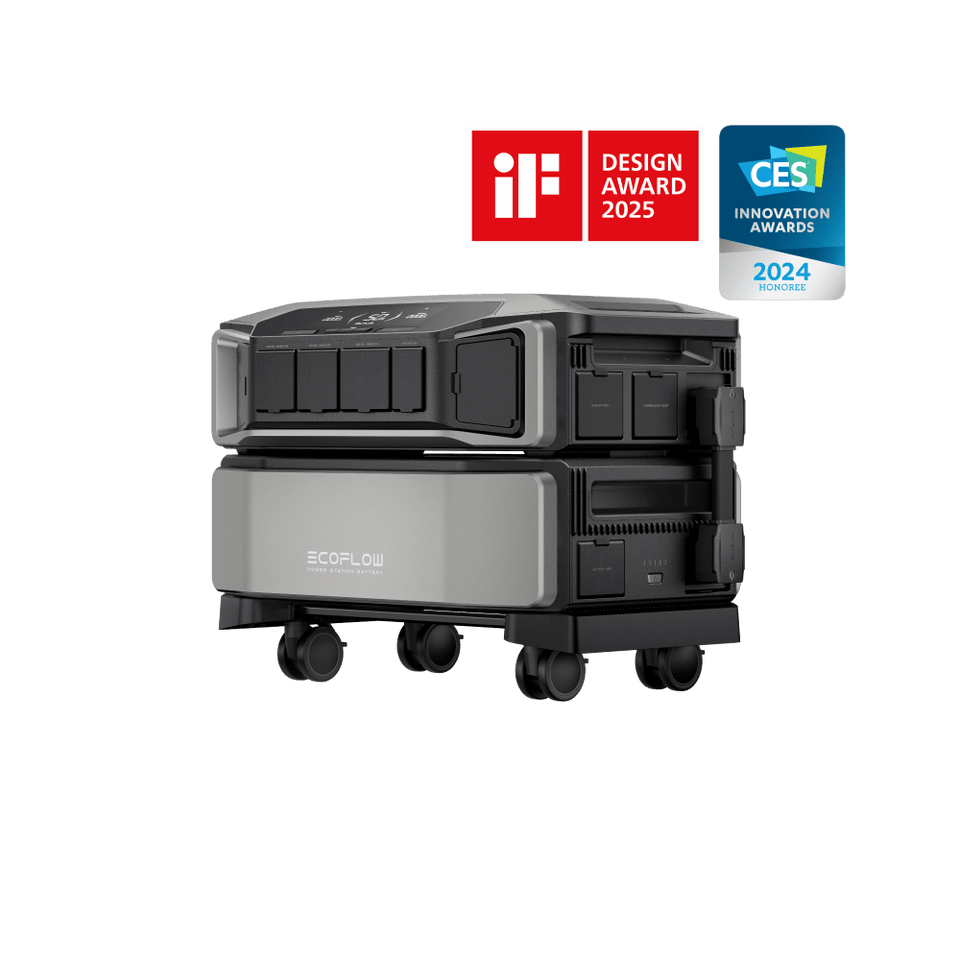
EcoFlow DELTA Pro Ultra
Built specifically for homeowners seeking high-voltage solar input (up to 5,600W) and modular 6kWh-per-stack scaling, though total kit cost and modular footprint exceed casual portable needs.

Anker SOLIX F3800
One of the most approachable plug-and-play 120V/240V wheeled units thanks to built-in NEMA 14-50R and L14-30R ports, though high idle overhead on light loads and the 60V solar cap (on the original non-Plus SKU) require careful sizing.
Frequently Asked Questions
How does the Jackery Explorer 5000 Plus compare on price and capacity to the Anker SOLIX F3800?+
At a typical US street price around $2,999, the Jackery Explorer 5000 Plus provides 5,040Wh of capacity and 7,200W continuous (14,400W surge) output versus 3,840Wh and 6,000W continuous (9,000W surge) on the original Anker SOLIX F3800—giving Jackery 31% more base energy storage and high-voltage 135V–450V solar support for roughly the same street cost.
Can the Jackery Explorer 5000 Plus charge with regular portable solar panels?+
Yes, via its Low-PV ports (16V–60V Voc, up to 600W per port / 1,200W combined). However, accessing the full 4,000W solar ceiling requires using the dedicated High-PV input, which requires a minimum of 135V up to 450V Voc.
Does the Explorer 5000 Plus require an electrician for whole-home circuits?+
Yes. While you can plug corded 120V appliances or 240V equipment directly into the chassis outlets, connecting the Explorer 5000 Plus or the Jackery Smart Transfer Switch to residential home circuits requires listed transfer equipment and installation by a licensed electrician in compliance with NEC and local codes.
Sources & Technical References
- View Source →[1]Manufacturer SpecificationJackery US OfficialVerified 2026-11-24Jackery Explorer 5000 Plus Official Product Specifications
5,040Wh LFP capacity, 7,200W/14,400W AC specs, High-PV (135-450V) and Low-PV (16-60V) limits, and warranty terms.
- View Source →[2]Technical & Safety StandardNational Fire Protection Association (NFPA)Verified 2026-11-24NFPA 70 National Electrical Code (NEC) Transfer Equipment & Standby Power Overview
Governs transfer switches, panel interlocks, and prohibition of unsafe backfeeding on US residential electrical panels.
- View Source →[3]Government Research ResourceNational Renewable Energy Laboratory (NREL)Verified 2026-11-24PVWatts & US Peak Sun Hours Reference Data
Documents regional peak sun hours and real-world photovoltaic derating factors (ambient heat, angle, shading, controller loss).
Model & Brand Comparisons
Related Sizing Guides & Tools
- 120V vs. 240V Home Backup Explained: Split-Phase Circuits, Well Pumps & Transfer Safety →
- Continuous Output vs. Surge Output: Why Startup Spikes & Boost Modes Matter →
- Transfer Equipment & Professional Installation: Safe Home Backup Integration →
- Solar Input Limits & MPPT Explained: Voc Ceilings, Cold Weather & Panel Sizing →
- Calculate custom runtime for Jackery Explorer 5000 Plus →