EcoFlow vs. Anker SOLIX (2026): Modular Stacks vs. Plug-and-Play 240V
Compare EcoFlow and Anker SOLIX power stations across 240V architecture, solar Voc limits, inverter idle overhead, compact USB-C UPS units, and 5-year support.
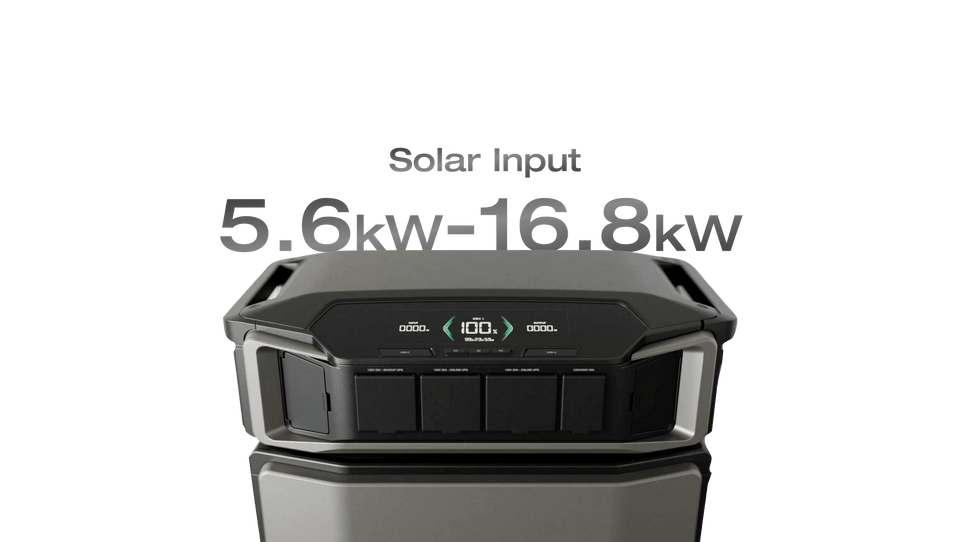
EcoFlow and Anker SOLIX both back their current LiFePO4 lineups with 5-year US warranties and span compact travel gear to whole-home 240V backup. EcoFlow leads in solar input ceilings (up to 5,600W / 450V Voc on DELTA Pro Ultra and 1,000W dual MPPT on DELTA 3 Plus), modular split lifting weight, and sub-freezing self-heating. Anker SOLIX stands out for aggressive street pricing (~$2,999 on the 240V F3800 with direct 14-50R/L14-30R ports; ~$229 on the 9.1 lb C300 router UPS) and Bellevue, WA North American support.

EcoFlow Models in Our Database
- EcoFlow DELTA 3 Plus — 1024Wh • 1800W AC • 27.6 lbs
- EcoFlow DELTA Pro Ultra — 6144Wh • 7200W AC • 181.8 lbs
Anker SOLIX Models in Our Database
- Anker SOLIX C300 — 288Wh • 300W AC • 9.1 lbs
- Anker SOLIX F3800 — 3840Wh • 6000W AC • 132.3 lbs
Brand Overview
EcoFlow and Anker SOLIX both maintain US operations in Washington state (EcoFlow in Seattle/Bellevue; Anker North America HQ in Bellevue) and back core LFP products with 5-year US warranties. Their product strategies diverge mainly on how much electrical complexity and upfront cost buyers want to take on: EcoFlow builds high-voltage, split-module engineering optimized for solar arrays and automated smart panels, whereas Anker SOLIX focuses on approachable plug-and-play packaging and aggressive street pricing.
Key Differences
- 240V Home Architecture (
DELTA Pro Ultravs.F3800): The Anker SOLIX F3800 (3,840Wh,6,000WAC,~$2,999street) puts bothNEMA 14-50RandL14-30R240V ports right onto a single wheeled132.3 lbbox. The EcoFlow DELTA Pro Ultra (6,144Wh,7,200WAC,~$4,599street) uses a modular stacked design (~70 lbinverter +~111.8 lbbattery) scaling higher (90kWhvs.53.76kWh) with more continuous output. - Solar
VocHeadroom: Original Anker SOLIX F3800 stops at11V–60V Voc(2,400W), limiting stringing with rigid rooftop panels (addressed on the newerF3800 Plusup to165V Voc/3,200W). EcoFlow DELTA Pro Ultra accepts80V–450V Voc(4,000W) plus30V–150V Voc(1,600W) natively. - Compact & Travel Positioning: Anker’s
9.1 lbSOLIX C300 (~$229street) targets ultra-lightweight router<10 msUPS and140Wlaptop charging where300WAC suffices. EcoFlow’s27.6 lbDELTA 3 Plus (~$699street) serves buyers needing1,800WAC,1,000Wdual-MPPT solar, and USB HID UPS workstation telemetry.
Which Specifications Matter & Real-World Effects
- Dual-Voltage Inverter Overhead: CNET’s standardized refrigerator test recorded
~25.68 hourson the3,840WhAnker SOLIX F3800—illustrating how large6,000Wsplit-phase inverters lose noticeable standby energy on light intermittent120Vloads. Always size battery capacity (or addBP3800packs) with idle overhead in mind. - Cold-Weather Garage Readiness: EcoFlow DELTA Pro Ultra includes automatic battery self-heating down to
-4°F(-20°C) charging, whereas Anker F3800 and C300 enforce a standard32°F(0°C) minimum charging floor. - SKU Confusion Risks: Both brands require careful model checks—confirming
F3800vs.F3800 PlusandC300 AC (A1722)vs.C300 DCat Anker, and separatingDELTA 2,DELTA 3 Plus, andPro Ultraaccessory ecosystems at EcoFlow.
Best Use Cases
- Choose EcoFlow for: High-voltage residential solar backup (
80–450V), cold unheated garages (-4°Fheating),0 msOnline UPS ports, or1kWhsolar/HID UPS flexibility (DELTA 3 Plus). - Choose Anker SOLIX for: Cost-effective
120V/240Vemergency EV or manual transfer inlet power (F3800around$2,999street), or ultralight router/laptop protection (C300at$229).
Advantages & Trade-offs
Anker SOLIX lowers the financial and physical complexity barrier for buyers entering the 240V backup or sub-$250 travel tier, while giving up cold-weather battery self-heating, high solar Voc on the original F3800, and split-module stair ergonomics. EcoFlow demands a substantially larger Starter Kit investment for 240V systems in exchange for superior solar ceiling, battery heating, and modular scalability up to 90kWh.
Evidence Supporting the Conclusion
Official EcoFlow and Anker SOLIX datasheets verify exact wattage, solar Voc ranges (60V on F3800 vs 165V on F3800 Plus vs 450V on DELTA Pro Ultra), weights, and 5-year US warranty terms. CNET Labs provides independent test evidence illustrating F3800 idle overhead on cyclic fridge runs. For any residential transfer switch or Home Power Panel setup on either brand, work with a licensed electrician per NFPA 70 / NEC guidelines.
Final Decision Matrix
- You want high-voltage rigid solar string compatibility (80–450V Voc / 5,600W max on DELTA Pro Ultra)
- You prefer splitting lifting weight (~70 lb inverter + ~111.8 lb battery) and need -4°F automatic cell self-heating
- You want 1,000W dual-MPPT solar and HID USB UPS signaling in a 1,024Wh compact unit (DELTA 3 Plus)
- You want native 240V NEMA 14-50R and L14-30R outlets directly on a single wheeled chassis around $2,999 street (F3800)
- You want an ultralight 9.1 lb router/laptop <10 ms UPS tower with dual 140W USB-C ports under $250 (C300)
- You value Anker's established North American Bellevue support footprint and clean consumer simplicity
Frequently Asked Questions
How does Anker SOLIX F3800 solar input compare to EcoFlow DELTA Pro Ultra?+
The original Anker SOLIX F3800 caps solar input at 2,400W and 11–60V Voc, whereas the newer F3800 Plus raises limits to 3,200W and 11–165V Voc. EcoFlow DELTA Pro Ultra reaches 5,600W total using dual MPPT inputs spanning 80–450V (High-PV) and 30–150V (Low-PV).
Is Anker SOLIX F3800 easier to move than EcoFlow DELTA Pro Ultra?+
On flat garage floors, the F3800's single-chassis suitcase handle and wheels roll easily (~132.3 lbs). Going up or down stairs or loading into an SUV is harder because EcoFlow splits its 181.8 lb starter kit into a ~70 lb inverter and ~111.8 lb battery module.
What should buyers watch out for in Anker SOLIX model names?+
Verify exact SKUs carefully: the Anker SOLIX C300 (Model A1722) has 120V AC outlets while the C300 DC omits AC plugs entirely, and the original F3800 (60V solar / 14-50R + L14-30R) differs from the F3800 Plus (165V solar / TT-30R swap).
Sources & Technical References
- View Source →[1]Manufacturer SpecificationEcoFlow US OfficialVerified 2026-11-24EcoFlow DELTA Pro Ultra Product Page & Specifications
Official North American 120V/240V split-phase inverter and 6,144Wh LiFePO4 battery module specs.
- View Source →[2]Manufacturer User ManualEcoFlow Support DocumentationVerified 2026-11-24EcoFlow DELTA Pro Ultra User Manual & Technical Datasheet
Documents High-PV (80-450V, 15A, 4,000W) and Low-PV (30-150V, 15A, 1,600W) limits, operating temps, and UPS switching behavior.
- View Source →[3]Manufacturer SpecificationEcoFlow US OfficialVerified 2026-11-24EcoFlow DELTA 3 Plus Official Specifications
1,024Wh LFP, 1,800W continuous AC, 1,000W dual 500W MPPT solar, <10ms UPS, 1,500W X-Stream AC charging.
- View Source →[4]Manufacturer SpecificationAnker SOLIX US OfficialVerified 2026-11-24Anker SOLIX F3800 Portable Power Station Official Specifications
North American model specs including NEMA 14-50R, L14-30R, 6,000W output, 3,840Wh capacity, and 11-60V dual solar input.
- View Source →[5]Manufacturer SpecificationAnker SOLIX US OfficialVerified 2026-11-24Anker SOLIX F3800 Plus Official Product Page
Successor revision increasing PV voltage range up to 165V and solar input to 3,200W.
- View Source →[6]Manufacturer SpecificationAnker SOLIX US OfficialVerified 2026-11-24Anker SOLIX C300 Portable Power Station (Model A1722) Specifications
288Wh LFP AC-equipped model (distinct from DC-only C300 DC), 300W AC, 600W SurgePad, 100W XT60 solar, <10ms UPS.
- View Source →[7]Third-Party Independent ReviewCNETVerified 2026-11-24CNET Portable Power Station Lab Efficiency & Refrigerator Runtime Benchmarks
Documents standardized refrigerator runtime and round-trip efficiency testing including BLUETTI AC200L (77.76% RTE, >29h fridge test) and Anker SOLIX F3800 (~25.68h fridge stress runtime due to dual-voltage inverter overhead).
- View Source →[8]Technical & Safety StandardNational Fire Protection Association (NFPA)Verified 2026-11-24NFPA 70 National Electrical Code (NEC) Transfer Equipment & Standby Power Overview
Governs transfer switches, panel interlocks, and prohibition of unsafe backfeeding on US residential electrical panels.