EcoFlow DELTA Pro Ultra Review (2026): Modular 240V Home Backup & 5.6kW Solar Architecture
EcoFlow DELTA Pro Ultra US review: 6,144Wh LFP battery, 7,200W 120V/240V inverter, 5,600W dual MPPT solar limits, Smart Home Panel 2 trade-offs.
Built specifically for US homeowners seeking high-voltage solar input (up to 5,600W) and modular 6kWh-per-stack scaling, the EcoFlow DELTA Pro Ultra separates its 70 lb inverter head from 111.8 lb battery modules for manageable installation. Its native 7,200W 120V/240V split-phase output and 0 ms Online UPS mode are standout engineering strengths, though full home-panel integration requires the separate Smart Home Panel 2 or licensed transfer equipment, and independent usable-AC lab data remains unverified in our registry.
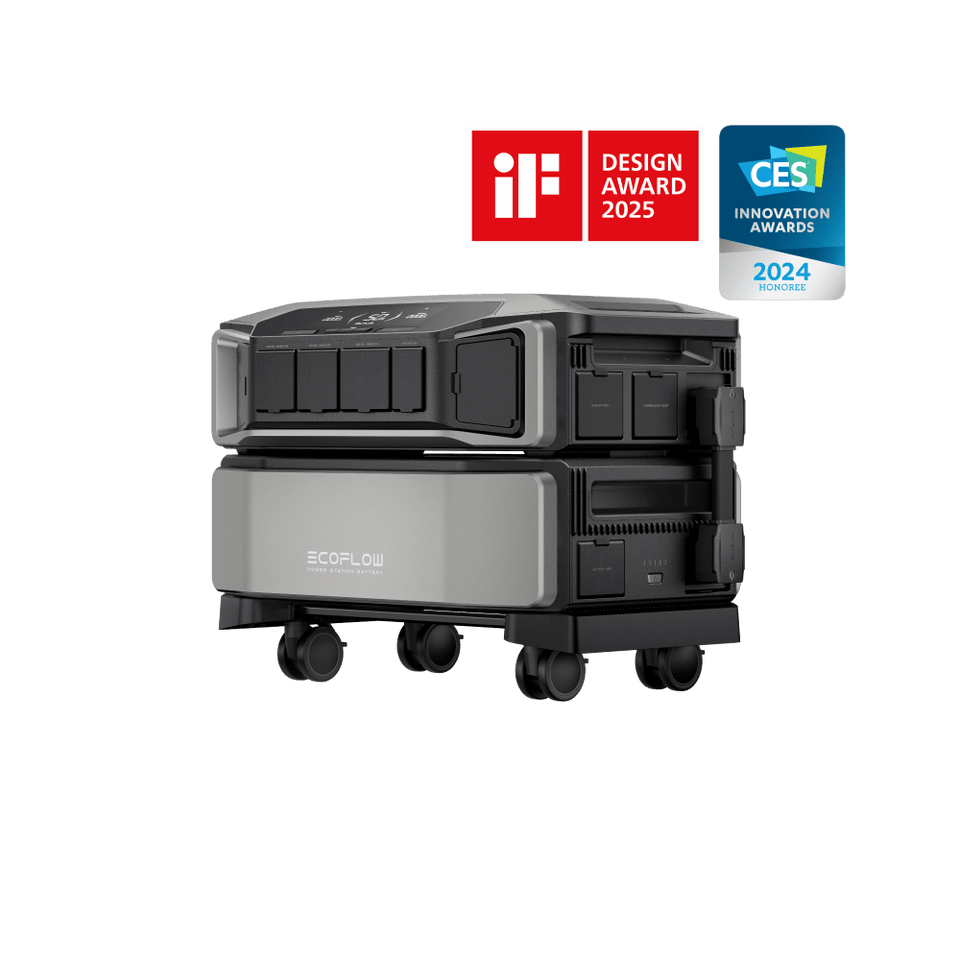
Starter Kit (1 Inverter + 1 Battery) MSRP $5,799; frequent US promotional pricing ~$4,199–$4,999 ($0.75/rated Wh at street pricing).
Official Hardware & Application Gallery
Sourced from EcoFlow official product media 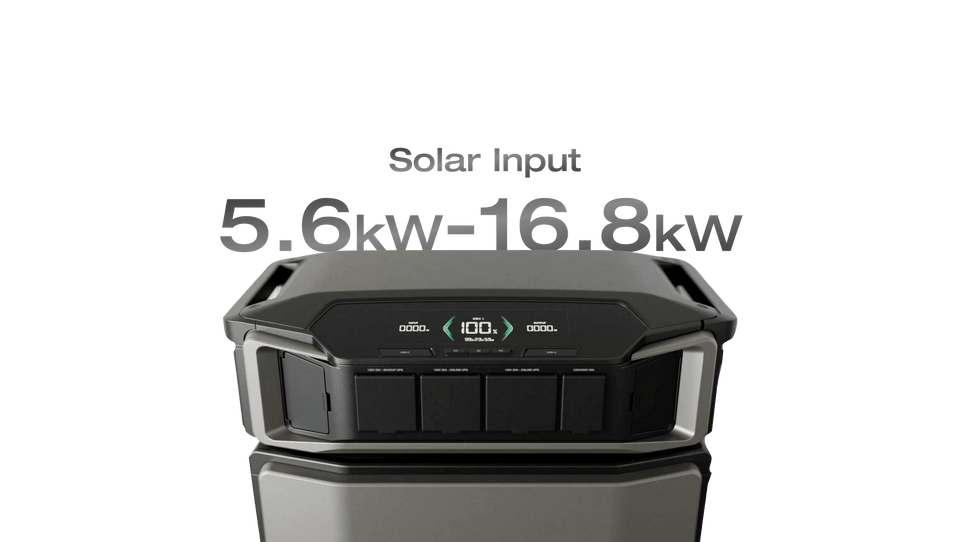
Key Advantages
- ✓Split-module design keeps individual lifting weights (70 lb inverter / 111.8 lb battery) more manageable than monolithic 130+ lb units
- ✓Dual MPPT solar ceiling (5,600W total, up to 450V Voc) supports rigid residential rooftop or ground arrays
- ✓Native 7,200W 120V/240V split-phase output with 0 ms Online UPS mode on supported ports
Trade-offs & Limitations
- !Full whole-home circuit integration requires the separate Smart Home Panel 2 or licensed transfer hardware
- !High base kit price ($4,199–$5,799) before adding transfer equipment or extra batteries
- !Independent standardized usable AC Wh lab data is not yet published in our verified source registry
Ideal Applications
- Homeowners building a multi-day 120V/240V backup system with a licensed electrician
- Off-grid cabins or workshops using high-voltage rigid solar arrays
Situations Where It May Not Fit
- Weekend campers or renters needing a single-piece carryable power station
- Buyers expecting whole-house coverage out of the box without transfer equipment
Complete Verified Specifications
| Specification | Verified Data | Data Provenance |
|---|---|---|
| Product Name & Revision | EcoFlow DELTA Pro Ultra (1st Gen Modular Home System (Inverter + 6kWh Battery)) | Manufacturer Spec |
| US Market Version | US 120V/240V Split-Phase Edition | Manufacturer Spec |
| Battery Capacity (Rated) | 6,144 Wh | Manufacturer Spec |
| Measured Usable AC Output | Not Independently Verified | Unverified |
| Battery Chemistry | LiFePO4 (LFP) | Manufacturer Spec |
| Published Cycle Life | 3,500+ cycles to 80% capacity — 0.5C/0.5C charge and discharge at 25°C (77°F) per EcoFlow specification | Manufacturer Spec |
| Continuous AC Output | 7,200 W (Not Applicable (native 7,200W continuous inverter; expandable to 21,600W with 3 inverters)) | Manufacturer Spec |
| Published Surge Output | 10,800 W | Manufacturer Spec |
| Published Surge Duration | Not Disclosed (duration in ms/seconds not published in primary summary datasheet) | Not Disclosed |
| AC Output Voltage | 120V / 240V Split-Phase | Manufacturer Spec |
| AC Outlet Types | 4 × 120V 20A NEMA 5-20R (backup/online UPS splits); 1 × 120V/240V 30A NEMA L14-30R; 1 × 240V/120V 30A NEMA L6-30R / High-output port configuration; EcoFlow Smart Home Panel 2 integration port | Manufacturer Spec |
| USB-A Output | 2 × USB-A (5V/2.4A, 12W max per port; 24W total) | Manufacturer Spec |
| USB-C Output | 2 × USB-C (5/9/12/15/20V 5A, 100W max per port; 200W total) | Manufacturer Spec |
| DC Output Ports | 1 × Anderson / Low-Voltage DC Output (12.6V, 30A, 378W max) | Manufacturer Spec |
| Max Solar Input | 5,600 W | Manufacturer Spec |
| Solar Input Voltage Range (Voc) | High-PV: 80V–450V Voc | Low-PV: 30V–150V Voc | Manufacturer Spec |
| Solar Input Current Limit | High-PV: 15A max | Low-PV: 15A max | Manufacturer Spec |
| MPPT Configuration | Dual independent MPPT inputs (4,000W High-PV + 1,600W Low-PV) | Manufacturer Spec |
| AC Charging Rate | 7,200 W max — Up to 1,800W (120V/15A wall outlet) or higher multi-kilowatt charging via 240V Smart Home Panel 2 / EV Level 2 adapter | Manufacturer Spec |
| Car / Alternator Charging | 12V/24V 8A max via Low-PV/DC input port | Manufacturer Spec |
| Published Recharge Time | Varies by AC source (approx. 3.5+ hrs on 120V 15A outlet; faster on 240V/5.6kW PV) | Mfr / Attributed Test |
| Expandable Capacity | Yes — up to 90,000 Wh (Up to 30,720Wh (5 × 6,144Wh batteries) per inverter; up to 90kWh across 3 parallel inverters with Smart Home Panel 2) | Manufacturer Spec |
| Supported Expansion Batteries | EcoFlow DELTA Pro Ultra 6kWh Battery Module | Manufacturer Spec |
| UPS / EPS Functionality | Online UPS mode (0 ms) on select ports and Backup EPS (~20 ms) via Smart Home Panel 2 | Manufacturer Spec |
| Published Switching Time | 0 ms Online UPS / <20 ms Automatic Transfer Switch | Manufacturer Spec |
| Weight | 181.8 lbs (Modular split weight: ~70 lbs (inverter) + ~111.8 lbs (1 × 6,144Wh battery)) | Manufacturer Spec |
| Dimensions (L × W × H) | Inverter: 27.2 × 18.9 × 8.4 in | Battery: 26.0 × 18.0 × 8.0 in | Manufacturer Spec |
| Operating Temp (Charging) | -4°F to 113°F (-20°C to 45°C) with automatic battery self-heating below freezing | Manufacturer Spec |
| Operating Temp (Discharging) | -4°F to 113°F (-20°C to 45°C) | Manufacturer Spec |
| Noise Rating (Manufacturer) | <30 dB under 2,000W load (manufacturer rated) | Manufacturer Spec |
| App & Connectivity | Wi-Fi & Bluetooth via EcoFlow App | Manufacturer Spec |
| Warranty & Verification Date | 5-Year Manufacturer Warranty (Verified 2026-11-24) | Manufacturer Policy |
| Pricing & Value per Rated Wh | Typical Street ~$4,599 ($0.75/rated Wh) | MSRP $5,799 ($0.94/rated Wh) | Checked 2026-11-24 |
Evidence & Data Provenance Breakdown
SolarGeneratorWholeHouse separates official specifications, third-party measurements, owner patterns, and editorial estimates.
Capacity (6,144Wh LiFePO4 (LFP)), continuous AC (7,200W), surge (10,800W), solar voltage limits (High-PV: 80V–450V Voc | Low-PV: 30V–150V Voc), and warranty (5-Year Manufacturer Warranty) are sourced directly from EcoFlow documentation.
Not Independently Verified in Our Source Registry: Independent laboratory usable-AC-Wh discharge benchmarks for this exact US SKU are not yet recorded in our verified registry; runtime figures below use clearly labeled engineering estimates.
Noise (<30 dB under 2,000W load (manufacturer rated)) and cycle retention (3,500+ cycles to 80% capacity) reflect EcoFlow's published ratings under manufacturer-specified test temperatures rather than independent long-term wear tests.
Owners commonly highlight quiet operation under moderate loads and straightforward wheeled trolley stacking, while noting that Smart Home Panel 2 installation adds meaningful electrician labor costs.
Unpublished fields: Surge duration (Not Disclosed (duration in ms/seconds not published in primary summary datasheet)).
Estimated AC Runtime Scenarios
| Sample Load | Estimated Runtime Range | Calculation Basis |
|---|---|---|
| Wi-Fi Router & Modem (~25W AC) | 191.7–216.3 hrs | Estimated 78%–88% usable AC range (untested model; accounts for inverter conversion & idle draw) |
| CPAP Machine (~45W AC avg) | 106.5–120.1 hrs | Estimated 78%–88% usable AC range (untested model; accounts for inverter conversion & idle draw) |
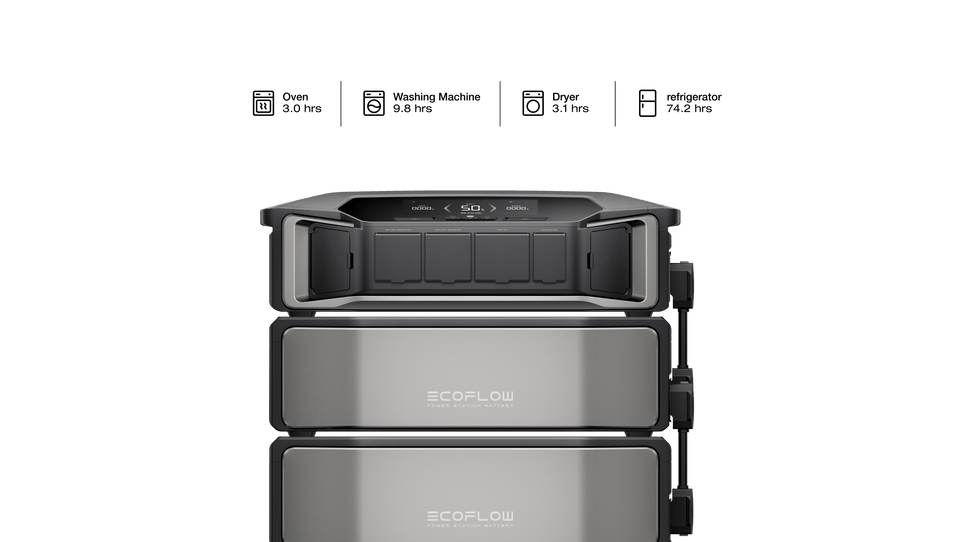
| Modern Refrigerator Avg Draw (~150W) | 31.9–36 hrs | Estimated 78%–88% usable AC range (untested model; accounts for inverter conversion & idle draw) |
| Home Office / Mixed Essential Load (~400W) | 12–13.5 hrs | Estimated 78%–88% usable AC range (untested model; accounts for inverter conversion & idle draw) |
| Portable AC / Heavy Load (~1,200W) | 4–4.5 hrs | Estimated 78%–88% usable AC range (untested model; accounts for inverter conversion & idle draw) |
Overview & US Market Positioning
The EcoFlow DELTA Pro Ultra (1st Generation US 120V/240V Split-Phase Edition) is engineered as a modular home-backup power stack rather than a casual tailgate or car-camping battery. While single-chassis competitors like the Anker SOLIX F3800 and Jackery Explorer 5000 Plus pack the inverter and primary battery cells into one 132 to 135 lb tower, EcoFlow splits the core architecture into a dedicated 70 lb inverter head stacked atop one or more 111.8 lb 6,144Wh battery modules on a wheeled trolley.
That physical split changes how US homeowners stage and scale residential backup. Moving a single starter kit still represents 181.8 lbs of combined hardware, yet lifting individual modules across thresholds, into utility rooms, or onto a garage trolley avoids wrestling a 134 lb monolith. Within the US market, the DELTA Pro Ultra competes directly against high-capacity 240V stations in our EcoFlow DELTA Pro Ultra vs. Anker SOLIX F3800 comparison, aiming squarely at multi-day residential outage preparedness, off-grid cabins, and workshops paired with high-voltage solar arrays.
Battery Capacity, Chemistry & Cycle Longevity
Each base DELTA Pro Ultra stack begins with 6,144Wh of rated LiFePO4 (LFP) storage. EcoFlow specifies a cycle life of 3,500+ cycles to 80% original capacity, verified under 0.5C/0.5C charge and discharge testing at 25°C (77°F). In practical residential backup use—where a system might experience 50 to 150 deep cycles per year rather than daily full-depth cycling—LFP cell chemistry keeps thermal runaway risk low and delays calendar degradation relative to legacy NMC packs. For deeper context on cell longevity trade-offs, see our LiFePO4 vs. NMC batteries guide.
What separates EcoFlow’s battery engineering in northern US climates is its published -4°F to 113°F (-20°C to 45°C) charging temperature window enabled by automatic battery self-heating below freezing. Most competing portable power stations—including the Anker SOLIX F3800, Jackery Explorer 5000 Plus, and Zendure SuperBase V4600—halt charging at 32°F (0°C) to protect LFP anodes from lithium plating. Automatic internal warming makes unheated garage or detached shed placement far more practical during winter ice storms, provided the battery reserves enough charge to power its internal heating elements.
Continuous AC Output, Surge Behavior & Voltage Support
The single-inverter starter kit delivers 7,200W continuous AC output in native 120V/240V split-phase architecture without needing an external phase-combiner box. Outlet hardware on the inverter includes four 120V 20A NEMA 5-20R receptacles, one 120V/240V 30A NEMA L14-30R twist-lock port, one 240V/120V 30A NEMA L6-30R / high-output port configuration, and the proprietary EcoFlow Smart Home Panel 2 integration port. DC ports round out direct device charging with two 100W USB-C ports, two 12W USB-A ports, and a 12.6V/30A (378W) Anderson output.
EcoFlow rates peak starting power at 10,800W surge, though the exact published surge duration in milliseconds or seconds is Not Disclosed in primary summary datasheets. Because 10,800W sits lower than the 14,400W surge rating published for the Jackery Explorer 5000 Plus, buyers planning to start 240V well pumps or older HVAC compressors should confirm exact Locked Rotor Amps (LRA) rather than assuming every motor starts cleanly. As outlined in our 120V vs. 240V home backup guide and continuous vs. surge output guide, connecting a split-phase station to residential circuits requires listed transfer equipment—such as a manual transfer switch, panel interlock, or Smart Home Panel 2—installed by a licensed electrician under NEC/NFPA 70 rules. Never use makeshift cords or attempt DIY breaker-panel modifications.
Solar Charging, AC Charging & Expansion Ecosystem
Solar intake is arguably the DELTA Pro Ultra’s strongest technical differentiator. The inverter integrates two independent MPPT inputs totaling 5,600W:
- High-PV Input: 80V–450V Voc, 15A max, up to 4,000W
- Low-PV Input: 30V–150V Voc, 15A max, up to 1,600W
Accepting up to 450V open-circuit voltage lets installers pair rigid residential-style solar arrays without hitting the low 60V Voc ceiling found on the original Anker SOLIX F3800. Notice, however, that the 30V minimum on the Low-PV port and 80V minimum on the High-PV port mean single 12V-nominal portable solar panels cannot wake the MPPT controllers on their own without proper voltage configuration compliant with manufacturer specs. You can model real-world recovery times using our Solar Charging Time Estimator and review safe array sizing principles in our solar input limits and MPPT guide.
On grid power, a standard US 120V/15A wall outlet tops out around 1,800W (roughly 3.5+ hours for 6,144Wh), while connecting via 240V Smart Home Panel 2 hardware or EV Level 2 adapters unlocks multi-kilowatt charging up to 7,200W when supported by battery stack configuration. Expansion scales smoothly from 6,144Wh up to 30,720Wh (five battery modules) on one inverter, or up to 90,000Wh (90kWh) and 21,600W across three parallel inverters linked through the Smart Home Panel 2. See our expandable battery systems guide for stack-planning math.
UPS/EPS Behavior, Cooling Noise & App Features
The DELTA Pro Ultra supports two distinct backup switching tiers: 0 ms Online UPS mode on designated backup inverter outlets and under-20 ms automatic transfer switching when paired with the Smart Home Panel 2. Online (double-conversion) UPS behavior keeps sensitive workstations, medical gear, and networking racks continuously conditioned against sudden grid brownouts, though users should keep in mind that online inverter standby draw consumes continuous energy when enabled. For switching threshold differences, check our UPS and EPS switching guide.
EcoFlow publishes a manufacturer acoustic rating of under 30 dB below 2,000W load, making light-to-moderate household operation notably unobtrusive in hallways or utility rooms—though noise levels above 2,000W are Not Disclosed and independent third-party dB sweeps are not recorded in our source registry. Wi-Fi and Bluetooth telemetry run through the EcoFlow app, enabling time-of-use scheduling, Storm Guard prep alerts, and per-circuit management when coupled with the Smart Home Panel 2.
Runtime Considerations & Real-World Performance Data
In our evidence registry, independent third-party laboratory usable AC watt-hour measurements and standardized round-trip efficiency figures for the US DELTA Pro Ultra starter kit are Not Independently Verified. Until peer-reviewed bench testing with controlled ambient temperatures and calibrated power analyzers is published, runtime estimates must rely on transparent AC conversion bands (78% to 88% of the 6,144Wh battery, or roughly 4,792Wh to 5,407Wh usable AC energy depending on load ratio and inverter idle draw):
- Wi-Fi Router & Modem (~25W AC): Approx. 191.7 to 216.3 hours (note that at ultra-low 25W loads, high-capacity 7.2kW split-phase inverter idle draw can push real-world efficiency toward or below the lower end of that band).
- CPAP Machine (~45W AC avg, humidifier off): Approx. 106.5 to 120.1 hours (using DC output where supported avoids AC inverter overhead).
- Modern Refrigerator (~150W avg draw): Approx. 31.9 to 36.0 hours per 6,144Wh battery module.
- Home Office / Essential Mixed Load (~400W): Approx. 12.0 to 13.5 hours.
- Portable AC / Space Heating (~1,200W): Approx. 4.0 to 4.5 hours.
For multi-day outages with a 400W average essential load, adding a second 6,144Wh battery (12,288Wh total) or pairing even 1,500W to 2,500W of solar input dramatically changes outage resilience. Plug your exact home loads into our Battery Runtime Estimator and Appliance Wattage Calculator before choosing battery count.
Build Quality, Portability & Dimensions
Built around industrial sheet-metal and reinforced polymer enclosures, the inverter measures 27.2 × 18.9 × 8.4 inches (~70 lbs) and each battery measures 26.0 × 18.0 × 8.0 inches (~111.8 lbs), stacking vertically onto a detachable rolling base. Unlike the Jackery Explorer 2000 v2 or even wheeled 132 lb all-in-one stations, the DELTA Pro Ultra is fundamentally a semi-stationary residential or cabin appliance. It rolls cleanly across concrete garages and driveways, yet lifting a 111.8 lb battery module into a pickup bed still takes two people or a ramp.
Advantages, Disadvantages & Ideal Applications
Key Advantages
- Modular split-stack design keeps individual lifting components lighter (70 lb inverter / 111.8 lb battery) than monolithic 130+ lb 240V towers while scaling up to 90kWh.
- Industry-leading 5,600W dual-MPPT solar input (including an 80V–450V High-PV channel) accommodates rigid residential-grade solar arrays.
- Native 7,200W 120V/240V output, 0 ms Online UPS outlets, and automatic below-freezing battery self-heating down to -4°F.
Trade-offs & Limitations
- Starter Kit investment ($4,199–$5,799) climbs substantially once you add a Smart Home Panel 2, inlet equipment, and licensed electrician installation labor.
- Published surge duration is Not Disclosed, and 10,800W peak surge trails the Jackery Explorer 5000 Plus (14,400W).
- Independent lab usable AC Wh and round-trip efficiency measurements remain Not Independently Verified in our registry.
Ideal Applications: Homeowners seeking a serious multi-day 120V/240V critical-circuit backup core with professional transfer equipment, off-grid cabin owners utilizing high-voltage solar strings, and cold-climate installations where garage temperatures dip below freezing.
Price, Value per Rated Wh & Warranty
At its $5,799 MSRP, the single-inverter + single-battery Starter Kit works out to $0.94 per rated Wh, dropping to $0.75 per rated Wh at its typical US promotional street price of $4,599 (and as low as $0.68/Wh during $4,199 seasonal sales). Because independent usable AC Wh data is not yet verified, price per measured usable AC Wh is Not Independently Verified (check our Price per Wh Calculator for side-by-side comparisons). Compared with the Jackery Explorer 5000 Plus ($0.60/rated Wh at $2,999 street), EcoFlow charges a noticeable premium—justified primarily if you need EcoFlow’s modular 6kWh stack ergonomics, 5,600W solar ceiling, or below-freezing self-heating battery pack. Coverage includes a 5-Year Manufacturer Warranty backed by EcoFlow US support.
Close Alternatives to Consider
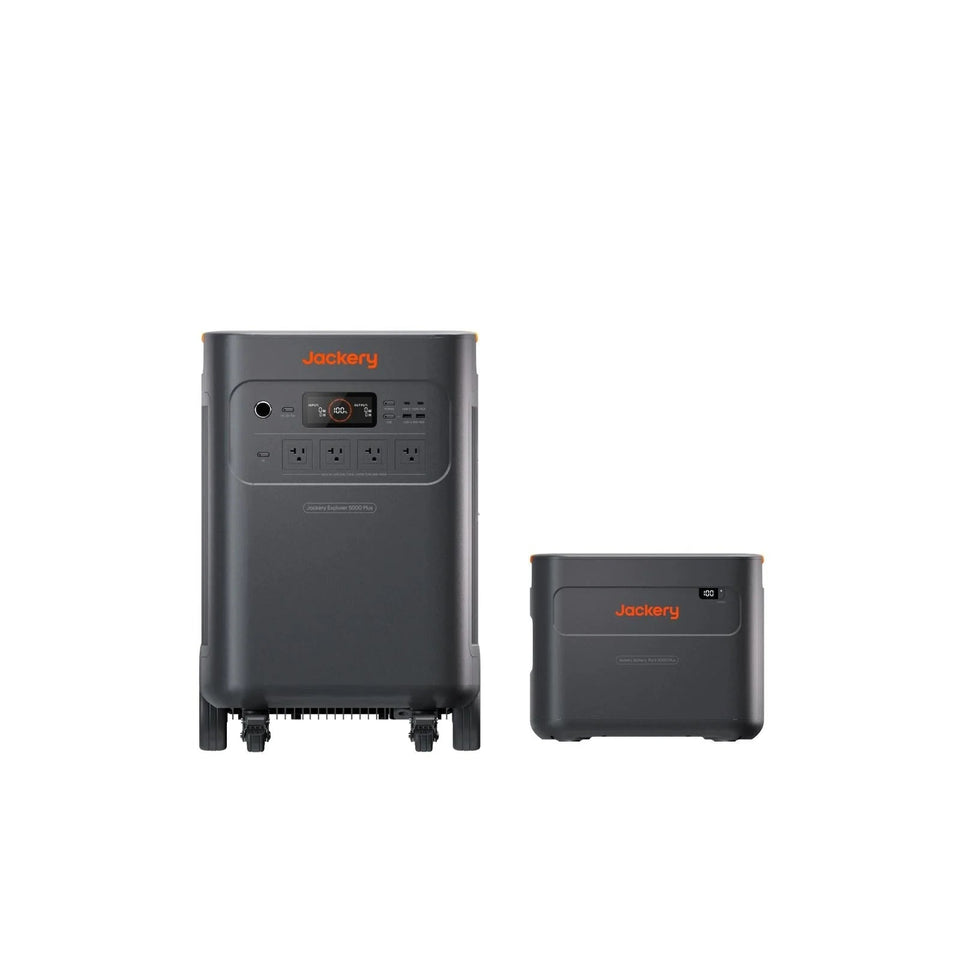
Jackery Explorer 5000 Plus
Combines a 5,040Wh LFP core, 7,200W split-phase output, 14,400W published surge headroom, and both High-PV (135–450V) and Low-PV solar inputs in a single wheeled chassis.

Anker SOLIX F3800
One of the most approachable plug-and-play 120V/240V wheeled units thanks to built-in NEMA 14-50R and L14-30R ports, though high idle overhead on light loads and the 60V solar cap (on the original non-Plus SKU) require careful sizing.
Frequently Asked Questions
Can a single EcoFlow DELTA Pro Ultra Starter Kit power an entire house?+
A single inverter outputs 7,200W continuous at 120V/240V split-phase from a 6,144Wh base battery, which is sufficient for essential home circuits such as refrigerators, lighting, internet hardware, sump pumps, and gas furnace blowers—not simultaneous electric central heat, tankless electric water heaters, or multiple heavy central AC units. True home-circuit backup also requires listed transfer equipment installed by a licensed electrician.
What is the difference between the High-PV and Low-PV solar ports on the DELTA Pro Ultra?+
According to the EcoFlow DELTA Pro Ultra technical manual, the High-PV port accepts 80V to 450V Voc at up to 15A (4,000W max) for rigid residential-style solar strings, while the Low-PV port accepts 30V to 150V Voc at up to 15A (1,600W max) for smaller portable or ground arrays. Both MPPT channels operate independently for a combined 5,600W ceiling.
Has the EcoFlow DELTA Pro Ultra usable AC capacity been independently lab tested here?+
Not Independently Verified in our source registry. While capacity, wattage, solar limits, and self-heating temperature ranges are verified from EcoFlow US specifications and manuals, standardized third-party usable AC Wh benchmarks are not yet recorded, so runtime tables reflect an estimated 78% to 88% AC conversion range.
Sources & Technical References
- View Source →[1]Manufacturer SpecificationEcoFlow US OfficialVerified 2026-11-24EcoFlow DELTA Pro Ultra Product Page & Specifications
Official North American 120V/240V split-phase inverter and 6,144Wh LiFePO4 battery module specs.
- View Source →[2]Manufacturer User ManualEcoFlow Support DocumentationVerified 2026-11-24EcoFlow DELTA Pro Ultra User Manual & Technical Datasheet
Documents High-PV (80-450V, 15A, 4,000W) and Low-PV (30-150V, 15A, 1,600W) limits, operating temps, and UPS switching behavior.
- View Source →[3]Technical & Safety StandardNational Fire Protection Association (NFPA)Verified 2026-11-24NFPA 70 National Electrical Code (NEC) Transfer Equipment & Standby Power Overview
Governs transfer switches, panel interlocks, and prohibition of unsafe backfeeding on US residential electrical panels.
- View Source →[4]Government Research ResourceNational Renewable Energy Laboratory (NREL)Verified 2026-11-24PVWatts & US Peak Sun Hours Reference Data
Documents regional peak sun hours and real-world photovoltaic derating factors (ambient heat, angle, shading, controller loss).
Model & Brand Comparisons
Related Sizing Guides & Tools
- 120V vs. 240V Home Backup Explained: Split-Phase Circuits, Well Pumps & Transfer Safety →
- Transfer Equipment & Professional Installation: Safe Home Backup Integration →
- Solar Input Limits & MPPT Explained: Voc Ceilings, Cold Weather & Panel Sizing →
- Expandable Battery Systems Explained: Modular Stacks, Cascade Cables & Hidden Costs →
- Calculate custom runtime for EcoFlow DELTA Pro Ultra →