Portable Power Station vs. Gas Generator: Noise, Safety, Runtime & Cost Trade-Offs
An objective comparison of lithium portable power stations and gas or dual-fuel inverter generators for home backup, indoor safety, multi-day outages, and hybrid pairing.
Portable power stations excel for quiet, zero-exhaust indoor use, instant UPS switchover, and solar recharging, whereas gas or dual-fuel inverter generators deliver far more energy per dollar and indefinite runtime during multi-day grid failures as long as fuel is available outdoors. Many homeowners get the best reliability by pairing a power station indoors with a small gas generator outside for rapid daytime battery recharges.
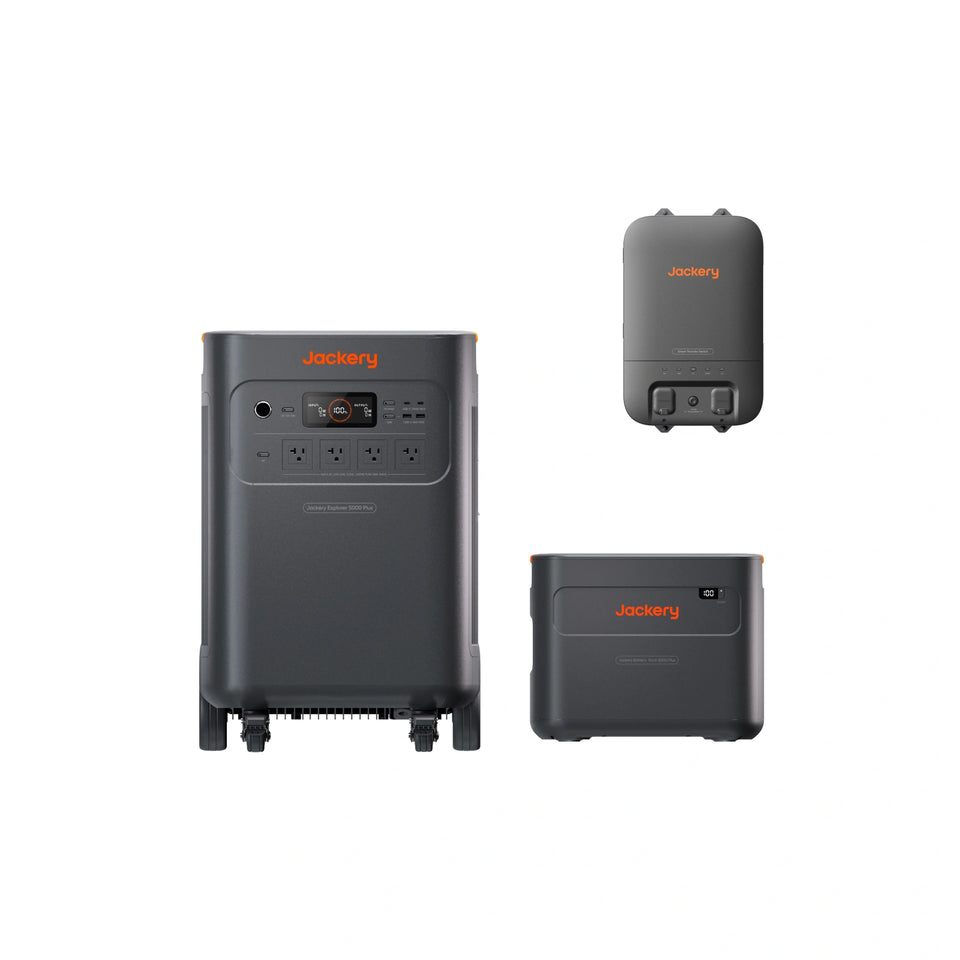
Key Technical Takeaways
- Gas generators emit lethal carbon monoxide and must only operate outdoors far from windows and vents; power stations produce zero exhaust indoors, though electrical and battery safety rules still apply.
- Fuel cans pack far higher energy density for multi-day storms than batteries alone, especially when winter clouds limit solar production.
- Using a gas inverter generator outdoors for 1.5–2 hours per day to recharge an LFP power station cuts fuel burn and lets you sleep quietly indoors.
Buyers researching emergency power often frame the decision as an all-or-nothing choice between a lithium portable power station and a gas or dual-fuel inverter generator. In practice, these two technologies solve different engineering problems. Comparing them honestly on energy density, indoor safety, acoustic levels, maintenance, and total cost reveals when each makes sense—and why combining both is often the most practical storm strategy.
Indoor Safety vs. Outdoor Carbon Monoxide Risk
The single biggest practical difference is where each machine can operate safely:
- Gas and Dual-Fuel Generators: Combustion generators emit colorless, odorless carbon monoxide (CO) and hot exhaust. They must never be operated inside garages, basements, enclosed porches, or near open windows, doors, or HVAC intakes. Even with an open garage door, fatal CO concentrations can build rapidly indoors.
- Portable Power Stations: Battery-powered stations produce zero tailpipe exhaust and require no combustible liquid fuel storage, making them suitable for apartments, bedrooms, medical equipment areas, and indoor essential-load setups. That said, no high-capacity lithium battery system is completely risk-free: electrical overload, damaged cords, blocked cooling airflow, water intrusion, or improper residential wiring still pose shock or thermal hazards. Review our Battery Storage & Safety Guide and Transfer Equipment Guide before deploying home backup gear.
Side-by-Side Comparison: Battery Station vs. Gas Inverter Generator
| Decision Factor | LiFePO4 Portable Power Station | Gas / Dual-Fuel Inverter Generator |
|---|---|---|
| Operating Location | Indoor or sheltered outdoor use (zero exhaust) | Outdoors only (at safe distance from building openings) |
| Acoustic Noise | Silent on DC/low AC; ~23–30 dB mfr-rated on quiet 1kWh–6kWh models under light load | Continuous engine hum (~52–68+ dB depending on frame & load) |
| Multi-Day Endurance | Fixed by battery Wh unless recharged by solar, grid, or generator | Extensible indefinitely as long as gasoline or propane cans last |
| Winter / Storm Clouds | Solar harvest drops 70%–85% under heavy overcast skies | Unaffected by cloud cover; cold starts require maintained oil/battery |
| Upfront Cost per Continuous kW | Higher (~$500–$1,100 for 2,200W–2,400W; ~$3,000–$4,600 for 240V) | Lower upfront cost per kW of continuous output |
| Routine Maintenance | Periodic SoC check every 3–6 months; no fuel or oil | Oil changes, air filters, spark plugs, fuel stabilizer, test runs |
| Automatic UPS Switchover | Built-in (0 ms to <=20 ms depending on model) |
Requires automatic standby transfer setup or manual startup |
Energy Density and Multi-Day Blackout Math
A standard 5-gallon gasoline container holds roughly 160,000+ thermal watt-hours of fuel energy; even after a small generator’s ~20%–25% engine-to-electrical conversion efficiency, that single red jug can yield 30,000 to 40,000 usable AC watt-hours (30–40 kWh). Replicating 30 kWh strictly with lithium batteries requires roughly five modular 6kWh expansion packs like the EcoFlow DELTA Pro Ultra system, weighing hundreds of pounds and costing well into five figures.
For a 4-to-24-hour outage, a 1,024Wh–2,048Wh unit like the EcoFlow DELTA 3 Plus or BLUETTI AC200L handles essentials cleanly without touching fuel. For a 5-day hurricane or ice storm without grid recovery, batteries alone only sustain heavy loads if paired with large solar arrays under clear skies.
Upfront Cost vs. Operating & Maintenance Burden
On a pure dollars-per-watt basis, a 2,200W portable inverter gas generator costs less upfront than a 2,048Wh / 2,400W LiFePO4 station. However, ownership friction differs sharply:
- Gas Generators Demand Active Upkeep: Stale ethanol gasoline gums up carburetors if neglected; propane dual-fuel models avoid carburetor varnish but still require engine oil breaks, periodic load exercise, weather protection, and safely stored fuel rotation.
- Power Stations Eliminate Engine Servicing: Once charged to an optimal storage level (typically 50%–80% per manufacturer instructions), an LFP unit sits quietly in a closet with minimal self-discharge and requires no oil or spark plugs—only a periodic charge check every few months.
The Hybrid Strategy: Why Many Homes Use Both
You do not have to choose exclusively between them. One of the most efficient emergency power architectures combines a midsize power station indoors with a compact inverter gas generator outdoors:
- Overnight Quiet Power: Run your refrigerator, Wi-Fi router, LED lights, and CPAP overnight from the power station inside your home without listening to an engine or leaving doors cracked for extension cords.
- High-Rate Daytime Recharging: Modern LFP power stations accept rapid AC charging—up to 1,400W–1,800W on units like the Pecron E1500LFP, Jackery Explorer 2000 v2, and Anker SOLIX F3800, or up to 2,400W on the BLUETTI AC200L. An outdoor inverter generator can refill a 1.5kWh–2kWh battery in roughly 1.5 to 2 hours running near its optimal efficiency band, rather than idling for 24 hours straight at 10% load.
- Solar Topping: Whenever sun breaks through, portable or rooftop solar panels offset daytime fuel consumption via our Solar Charging Time Estimator.
Verify that any generator used to recharge a power station produces clean pure sine wave AC power (inverter generators are strongly preferred over noisy open-frame construction generators whose voltage fluctuations may cause sensitive power station chargers to reject AC input). Always operate combustion equipment outdoors away from structures and use our Wattage Calculator to establish your real daily kWh budget first.

Frequently Asked Questions
Can a portable power station completely replace a gas generator for a week-long outage?+
Only if your daily energy demand stays within your battery reserve plus reliable solar recharge—or if you own a very large expandable battery bank. During winter ice storms or extended cloudy weather where solar yields drop sharply, a fuel generator remains far more resilient for prolonged multi-day loads.
Are portable power stations completely safe to run inside a bedroom or apartment?+
They eliminate carbon monoxide and fuel fire hazards, making them suitable for indoor use where combustion engines are prohibited. However, no battery system is completely risk-free: you still must avoid blocking cooling vents, prevent moisture exposure, stay within outlet ratings, and keep battery packs away from heat sources.
How do noise levels compare between battery stations and inverter gas generators?+
Even quiet enclosed inverter gas generators typically operate around 52–65+ dB outdoors depending on load, whereas power stations run silently at low draws and are manufacturer-rated around 23–30 dB under light-to-moderate loads on models like the DJI Power 1000 and EcoFlow DELTA 3 Plus.
Sources & Technical References
- View Source →[1]Technical & Safety StandardNational Fire Protection Association (NFPA)Verified 2026-11-24NFPA 70 National Electrical Code (NEC) Transfer Equipment & Standby Power Overview
Governs transfer switches, panel interlocks, and prohibition of unsafe backfeeding on US residential electrical panels.
- View Source →[2]Manufacturer SpecificationEcoFlow US OfficialVerified 2026-11-24EcoFlow DELTA 3 Plus Official Specifications
1,024Wh LFP, 1,800W continuous AC, 1,000W dual 500W MPPT solar, <10ms UPS, 1,500W X-Stream AC charging.
- View Source →[3]Manufacturer SpecificationDJI OfficialVerified 2026-11-24DJI Power 1000 Specifications & Official Overview
1,024Wh LFP, 2,200W continuous AC (V1 US model; V2 increases to 2,600W), dual 140W USB-C, 800W solar via MPPT adapter.
- View Source →[4]Manufacturer SpecificationBLUETTI US OfficialVerified 2026-11-24BLUETTI AC200L Portable Power Station Official Specifications
2,048Wh LFP, 2,400W continuous AC, 3,600W Power Lifting mode, NEMA TT-30R + 48V/8A DC RV port, 1,200W solar (12-145V).
- View Source →[5]Manufacturer SpecificationEcoFlow US OfficialVerified 2026-11-24EcoFlow DELTA Pro Ultra Product Page & Specifications
Official North American 120V/240V split-phase inverter and 6,144Wh LiFePO4 battery module specs.