Goal Zero Yeti 700 Review (2026): IPX4 Weather Resistance & 4,000-Cycle LFP Durability
Goal Zero Yeti 700 US review: 677Wh LFP, IPX4 splash resistance, 600W AC inverter, 200W solar ceiling, 5-year warranty, and price-per-Wh trade-offs.
The 6th-generation Goal Zero Yeti 700 trades aggressive inverter wattage and solar charging speed for an IPX4 weather-resistant exterior, sealed port covers, 4,000-cycle LiFePO4 chemistry, and a 5-year US warranty. However, with 600W continuous AC output, a 200W solar limit, unverified third-party usable AC Wh benchmarks, and ~$549 street pricing ($0.81/rated Wh), buyers prioritizing watts and solar speed per dollar get significantly more capability from peers like the BLUETTI AC70.
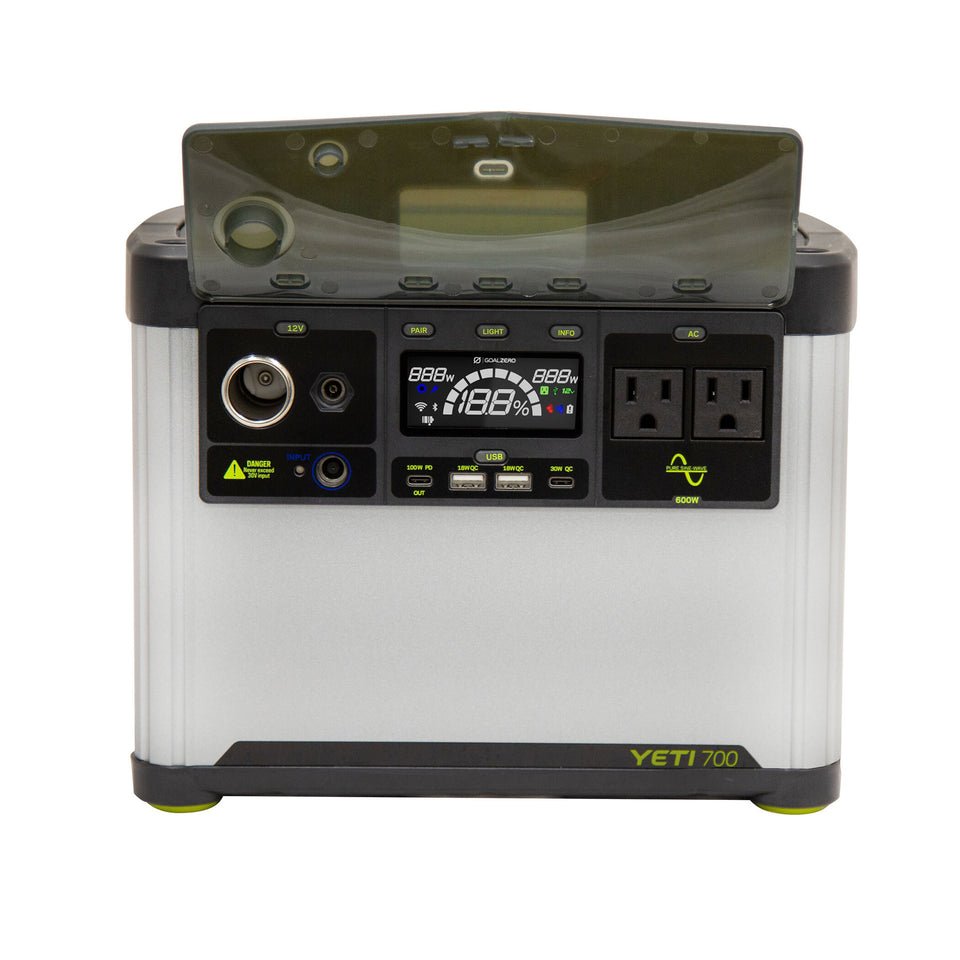
MSRP $699.95; retail promotions commonly $499–$649 ($0.81/rated Wh at street pricing).
Official Hardware & Application Gallery
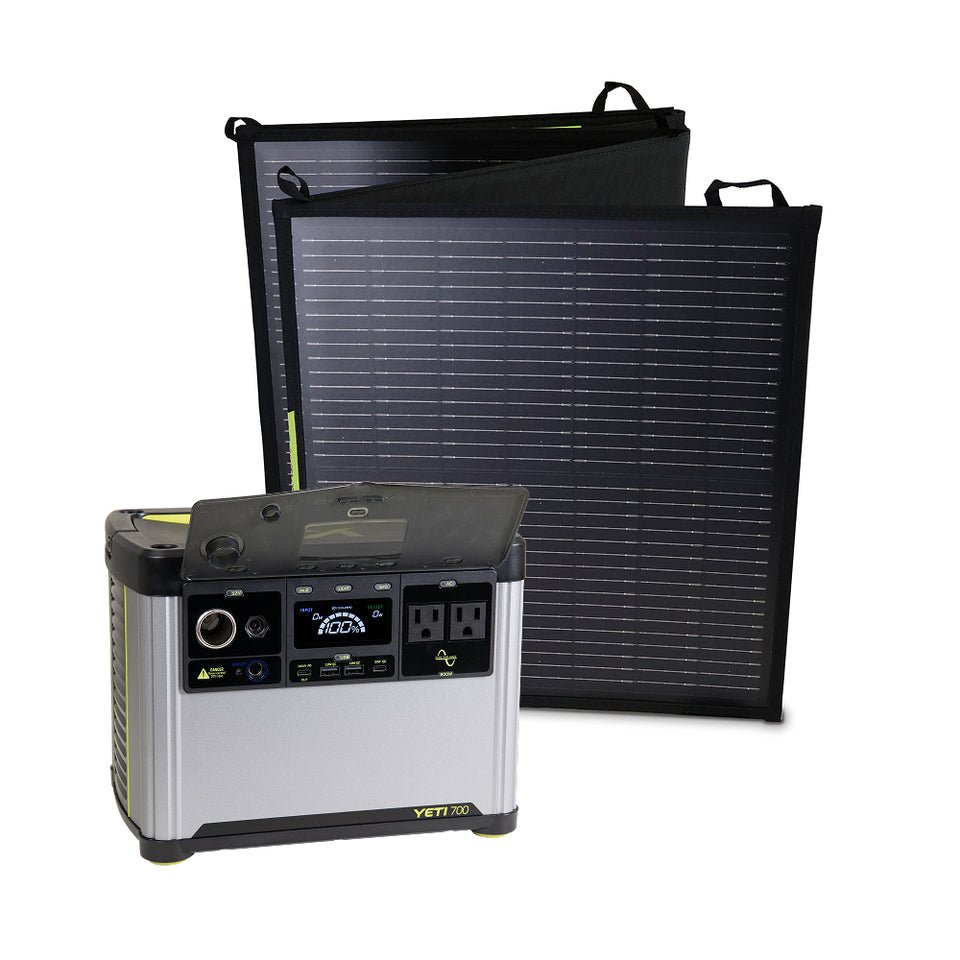
Sourced from Goal Zero official product media 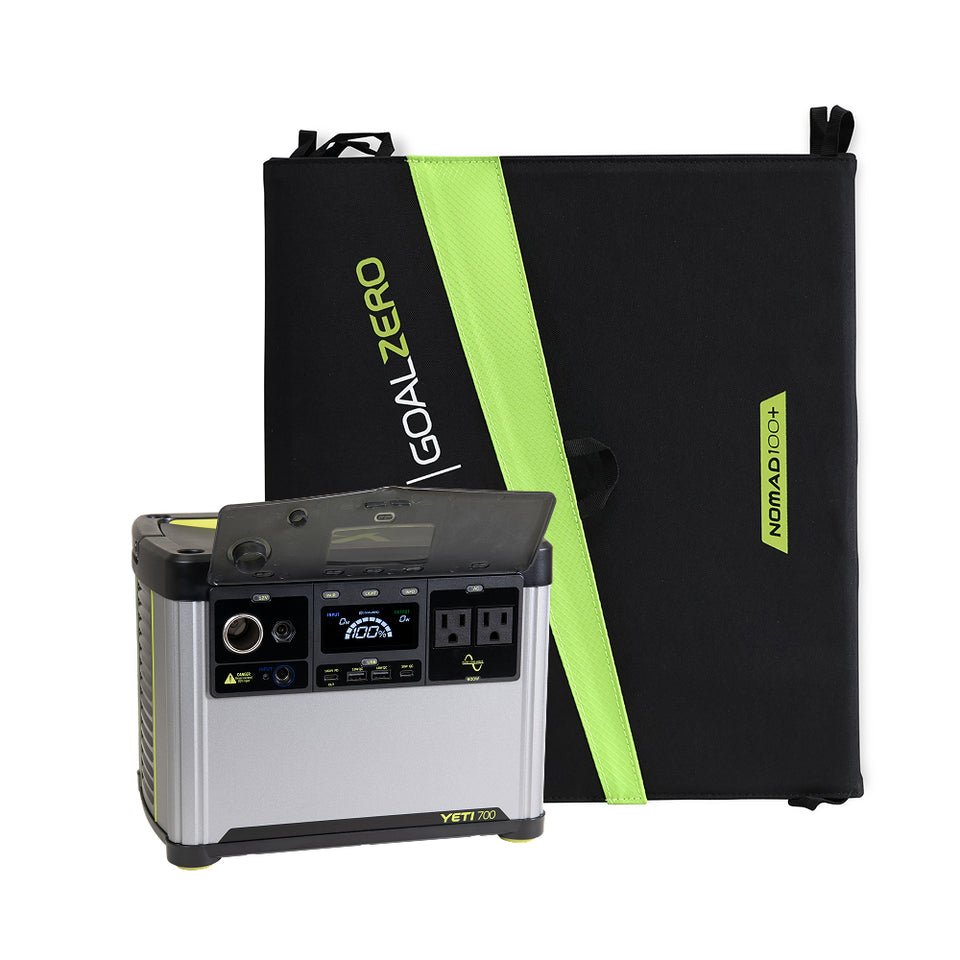
Key Advantages
- ✓IPX4 weather-resistant exterior and sealed port covers protect against camp splashes and dust
- ✓4,000-cycle LFP battery paired with a 5-year US warranty
- ✓20.3 lb compact shape packs neatly in truck beds and camp totes
Trade-offs & Limitations
- !600W continuous AC inverter and 200W solar input trail similarly priced peers like the BLUETTI AC70 (1,000W AC / 500W solar)
- !Higher MSRP per rated Wh than value-focused competitors
- !Exact UPS switching speed in ms is not published in primary public specification tables
Ideal Applications
- Overlanders, boaters, and damp-weather campers valuing IPX4 sealing over peak wattage
- 12V camp fridges, LED camp lighting, cameras, and laptop charging
Situations Where It May Not Fit
- Powering 1,000W+ cooking gear or hair dryers
- Buyers maximizing watts and solar speed per dollar
Complete Verified Specifications
| Specification | Verified Data | Data Provenance |
|---|---|---|
| Product Name & Revision | Goal Zero Yeti 700 (6th Generation LiFePO4 Yeti Series) | Manufacturer Spec |
| US Market Version | US 120V Edition | Manufacturer Spec |
| Battery Capacity (Rated) | 677 Wh | Manufacturer Spec |
| Measured Usable AC Output | Not Independently Verified | Unverified |
| Battery Chemistry | LiFePO4 (LFP) | Manufacturer Spec |
| Published Cycle Life | 4,000 cycles to 80% capacity — Manufacturer specification under standard lab cycling conditions | Manufacturer Spec |
| Continuous AC Output | 600 W (Not Applicable) | Manufacturer Spec |
| Published Surge Output | 1,000 W | Manufacturer Spec |
| Published Surge Duration | Not Disclosed | Not Disclosed |
| AC Output Voltage | 120V | Manufacturer Spec |
| AC Outlet Types | 2 × 120V Pure Sine Wave AC outlets | Manufacturer Spec |
| USB-A Output | 2 × USB-A (12W–18W class) | Manufacturer Spec |
| USB-C Output | 2 × USB-C (including 100W USB-C PD bidirectional + secondary USB-C) | Manufacturer Spec |
| DC Output Ports | 1 × 12V Regulated Cigarette Port + 12V 6mm ports | Manufacturer Spec |
| Max Solar Input | 200 W | Manufacturer Spec |
| Solar Input Voltage Range (Voc) | 15V–50V Voc (8mm / High-Power input limits per Goal Zero guide) | Manufacturer Spec |
| Solar Input Current Limit | Not Disclosed in summary spec (200W MPPT limit) | Manufacturer Spec |
| MPPT Configuration | Integrated MPPT solar charge controller (up to 200W) | Manufacturer Spec |
| AC Charging Rate | 500 W max — Up to 500W internal AC fast charging (~1.5 hrs) | Manufacturer Spec |
| Car / Alternator Charging | 12V car charging supported | Manufacturer Spec |
| Published Recharge Time | ~1.5 hrs via 500W AC charging; ~4–5 hrs under peak 200W solar | Mfr / Attributed Test |
| Expandable Capacity | Not Applicable — standalone weather-sealed chassis | Manufacturer Spec |
| Supported Expansion Batteries | Not Applicable | Manufacturer Spec |
| UPS / EPS Functionality | Pass-through charging / backup capability (exact ms rating Not Disclosed in public summary specs) | Manufacturer Spec |
| Published Switching Time | Not Disclosed (supports pass-through power) | Not Disclosed |
| Weight | 20.3 lbs (Approx. 9.2 kg rugged chassis with fold-flat handle and port covers) | Manufacturer Spec |
| Dimensions (L × W × H) | 11.3 × 7.8 × 8.6 in | Manufacturer Spec |
| Operating Temp (Charging) | 32°F to 104°F (0°C to 40°C) | Manufacturer Spec |
| Operating Temp (Discharging) | -4°F to 104°F (-20°C to 40°C) | Manufacturer Spec |
| Noise Rating (Manufacturer) | Not Disclosed | Not Disclosed |
| App & Connectivity | Wi-Fi & Bluetooth via Goal Zero App | Manufacturer Spec |
| Warranty & Verification Date | 5-Year Manufacturer Warranty (Verified 2026-11-24) | Manufacturer Policy |
| Pricing & Value per Rated Wh | Typical Street ~$549 ($0.81/rated Wh) | MSRP $699.95 ($1.03/rated Wh) | Checked 2026-11-24 |
Evidence & Data Provenance Breakdown
SolarGeneratorWholeHouse separates official specifications, third-party measurements, owner patterns, and editorial estimates.
Capacity (677Wh LiFePO4 (LFP)), continuous AC (600W), surge (1,000W), solar voltage limits (15V–50V Voc (8mm / High-Power input limits per Goal Zero guide)), and warranty (5-Year Manufacturer Warranty) are sourced directly from Goal Zero documentation.
Not Independently Verified in Our Source Registry: Independent laboratory usable-AC-Wh discharge benchmarks for this exact US SKU are not yet recorded in our verified registry; runtime figures below use clearly labeled engineering estimates.
Noise (Not Disclosed) and cycle retention (4,000 cycles to 80% capacity) reflect Goal Zero's published ratings under manufacturer-specified test temperatures rather than independent long-term wear tests.
Users value the rugged build, sealed port doors, and brand longevity, while pointing out that 600W output and 200W solar limits position it squarely as a light camp/12V station.
Unpublished fields: Surge duration (Not Disclosed).
Estimated AC Runtime Scenarios
| Sample Load | Estimated Runtime Range | Calculation Basis |
|---|---|---|
| Wi-Fi Router & Modem (~25W AC) | 21.1–23.8 hrs | Estimated 78%–88% usable AC range (untested model; accounts for inverter conversion & idle draw) |
| CPAP Machine (~45W AC avg) | 11.7–13.2 hrs | Estimated 78%–88% usable AC range (untested model; accounts for inverter conversion & idle draw) |
| Modern Refrigerator Avg Draw (~150W) | 3.5–4 hrs | Estimated 78%–88% usable AC range (untested model; accounts for inverter conversion & idle draw) |
| Home Office / Mixed Essential Load (~400W) | 1.3–1.5 hrs | Estimated 78%–88% usable AC range (untested model; accounts for inverter conversion & idle draw) |
Overview & US Market Positioning
With its 6th-generation Goal Zero Yeti 700 (US 120V Edition), Utah-based Goal Zero finally transitioned its compact camp lineup away from shorter-lived NMC lithium-ion cells to 4,000-cycle LiFePO4 (LFP) chemistry and a 5-year US warranty, while adding a practical IPX4 weather-resistant chassis with sealed port doors.
Yet on pure power-to-price metrics, the Yeti 700 asks buyers to pay a brand and ruggedness premium. Priced at $699.95 MSRP and typically retailing around $549 ($499–$649 promotions), it costs noticeably more than the $429 street-priced BLUETTI AC70—while offering 91Wh less battery capacity (677Wh vs. 768Wh), 40% lower continuous AC power (600W vs. 1,000W), and less than half the solar input speed (200W vs. 500W). Its niche is clear: overlanders, boaters, and damp-weather campers who prioritize IPX4 splash sealing, rugged 12V integration, and US customer support over peak inverter watts.
Battery Capacity, Chemistry & Cycle Longevity
Goal Zero specifies an exact capacity of 677.37Wh (listed as 677Wh) using LiFePO4 (LFP) cells rated for 4,000 cycles to 80% capacity under standard manufacturer lab conditions. That longevity leap fixes the primary weakness of earlier NMC Yeti generations—covered in our LiFePO4 vs. NMC batteries comparison—putting Goal Zero on equal cell-life footing with EcoFlow’s newest LFP units.
Thermal boundaries span 32°F to 104°F (0°C to 40°C) for charging and -4°F to 104°F (-20°C to 40°C) for discharging. There is no below-freezing self-heating element, so winter truck-bed users must bring the unit above freezing before applying solar or grid power.
Continuous AC Output, Surge Behavior & Voltage Support
The 120V pure sine wave inverter is intentionally modest: 600W continuous output and 1,000W peak surge (exact published surge duration is Not Disclosed). Unlike BLUETTI’s Power Lifting or EcoFlow’s X-Boost, Goal Zero does not offer a voltage-dropping resistive boost mode—600W continuous is a firm boundary. That comfortably covers laptops, camera chargers, CPAP units, LED string lights, Starlink dishes, and small blenders, while ruling out induction cooktops, microwaves, electric kettles, and 1,000W+ tools.
Port selection leans heavily toward traditional outdoor and 12V camping gear:
- 2 × 120V Pure Sine Wave AC outlets
- 2 × USB-C (including one 100W bidirectional USB-C PD + secondary USB-C) + 2 × USB-A (12W–18W class)
- 1 × 12V Regulated Cigarette Port + 12V 6mm ports
Having multiple 12V ports alongside a bidirectional 100W USB-C port serves truck campers and astrophotographers well without wasting conversion energy through the AC inverter.
Solar Charging, AC Charging & Expansion Ecosystem
Solar recovery is the Yeti 700’s sharpest operational limitation relative to modern peers. Its integrated MPPT controller caps solar intake at 200W max across a 15V to 50V Voc window (current limit Not Disclosed in summary specifications beyond the 200W cap; uses Goal Zero’s 8mm / High-Power input ecosystem). Recharging 677Wh at 200W peak requires roughly 4 to 5 hours under strong sun, and multi-day overcast weather leaves slim recovery margin compared with BLUETTI AC70’s 500W solar input. Estimate regional recovery times in our Solar Charging Time Estimator.
On wall power, however, Goal Zero modernized significantly: internal 500W AC fast charging eliminates legacy external power bricks and refills the 677Wh battery in approximately 1.5 hours. Bidirectional 100W USB-C PD and 12V car charging provide convenient vehicle top-offs on the road. Note that the weather-sealed Yeti 700 is non-expandable—no external battery ports are supported.
UPS/EPS Behavior, Cooling Noise & App Features
Another important specification gap lies in emergency backup switching. While Goal Zero confirms pass-through charging / backup capability, the exact UPS switching time in milliseconds is Not Disclosed in primary public spec sheets. Without a verified <20 ms or <10 ms switching guarantee, the Yeti 700 should not be bought as a dedicated desktop PC or NAS UPS (choose the EcoFlow DELTA 3 Plus or Anker SOLIX C300 if fast sub-10 ms switchover matters).
Manufacturer noise rating in dB is Not Disclosed, and independent dB measurements are absent from our source registry. On the plus side, Goal Zero includes both Wi-Fi and Bluetooth app connectivity—giving it remote Wi-Fi monitoring capability that the Bluetooth-only BLUETTI AC70 lacks.
Runtime Considerations & Real-World Performance Data
Independent third-party laboratory usable AC watt-hour measurements and standardized round-trip efficiency figures for the Goal Zero Yeti 700 are Not Independently Verified in our source registry. Applying our transparent 78% to 88% AC conversion estimation band to the 677Wh pack (528Wh to 596Wh estimated usable AC output):
- Wi-Fi Router & Modem (~25W AC): Approx. 21.1 to 23.8 hours (significantly longer if powered via 12V DC where applicable).
- CPAP Machine (~45W AC): Approx. 11.7 to 13.2 hours (more via 12V DC).
- Modern Refrigerator (~150W avg): Approx. 3.5 to 4.0 hours continuous draw (roughly 5–7 hours cyclic—useful only as brief emergency bridge power).
- Home Office / Mixed Essential Load (~400W): Approx. 1.3 to 1.5 hours.
For 12V compressor camp coolers (~30W–45W intermittent DC draw), running directly off the Yeti 700’s regulated 12V socket avoids AC inverter idle loss altogether—typically spanning a full weekend of warm-weather camping. Model tailored gear lists with our Battery Runtime Estimator.
Build Quality, Portability & Dimensions
Build durability is where the Yeti 700 earns its keep. Measuring 11.3 × 7.8 × 8.6 inches and weighing 20.3 lbs (~9.2 kg), it features thick rubberized impact corners, a sturdy fold-flat handle, and sealed port gaskets providing IPX4 splash resistance when covers are closed (alongside UL and FCC listings). That extra weather protection makes it noticeably more reassuring on open boat decks, dusty Overland tailgates, or damp Pacific Northwest camp tables than vented-chassis competitors.
Advantages, Disadvantages & Ideal Applications
Key Advantages
- IPX4 weather-resistant housing with protective port covers shields against rain spray and camp dust.
- 4,000-cycle LFP battery paired with a 5-Year US Manufacturer Warranty and local US-based brand heritage.
- Wi-Fi + Bluetooth app support, 500W internal AC fast charging (~1.5 hrs), and compact 20.3 lb footprint.
Trade-offs & Limitations
- 600W AC ceiling and 200W max solar input trail similarly priced competitors like the BLUETTI AC70 (1,000W AC / 500W solar).
- Exact UPS switching time (ms), noise dB rating, and usable AC Wh efficiency are Not Disclosed / Not Independently Verified.
- Non-expandable and priced at a noticeable premium per watt-hour.
Ideal Applications: Boaters, anglers, overland travelers, and damp-climate tent campers powering 12V coolers, cameras, lighting, and laptops who specifically value IPX4 weather sealing and Goal Zero’s 5-year US support over maximum AC or solar watts.
Price, Value per Rated Wh & Warranty
At its $699.95 MSRP, the Yeti 700 carries a steep $1.03 per rated Wh, moderating to $0.81 per rated Wh at its typical $549 street price ($499–$649 promotional band). Compared directly with the BLUETTI AC70 ($0.56/rated Wh at $429 street, with lab-verified 705–730.59 Wh AC output), the Yeti 700 costs roughly 28% more upfront for 91Wh less storage, making it a poor value purely on paper specs. Cost per measured usable AC Wh remains Not Independently Verified. Goal Zero backs US purchases with a 5-Year Manufacturer Warranty.
Close Alternatives to Consider

BLUETTI AC70
With 705–730.6 Wh of independently measured usable AC output from a 768Wh battery and 500W solar input at ~$399–$449 street price, the AC70 punches above typical 500Wh–700Wh units.
Anker SOLIX C300
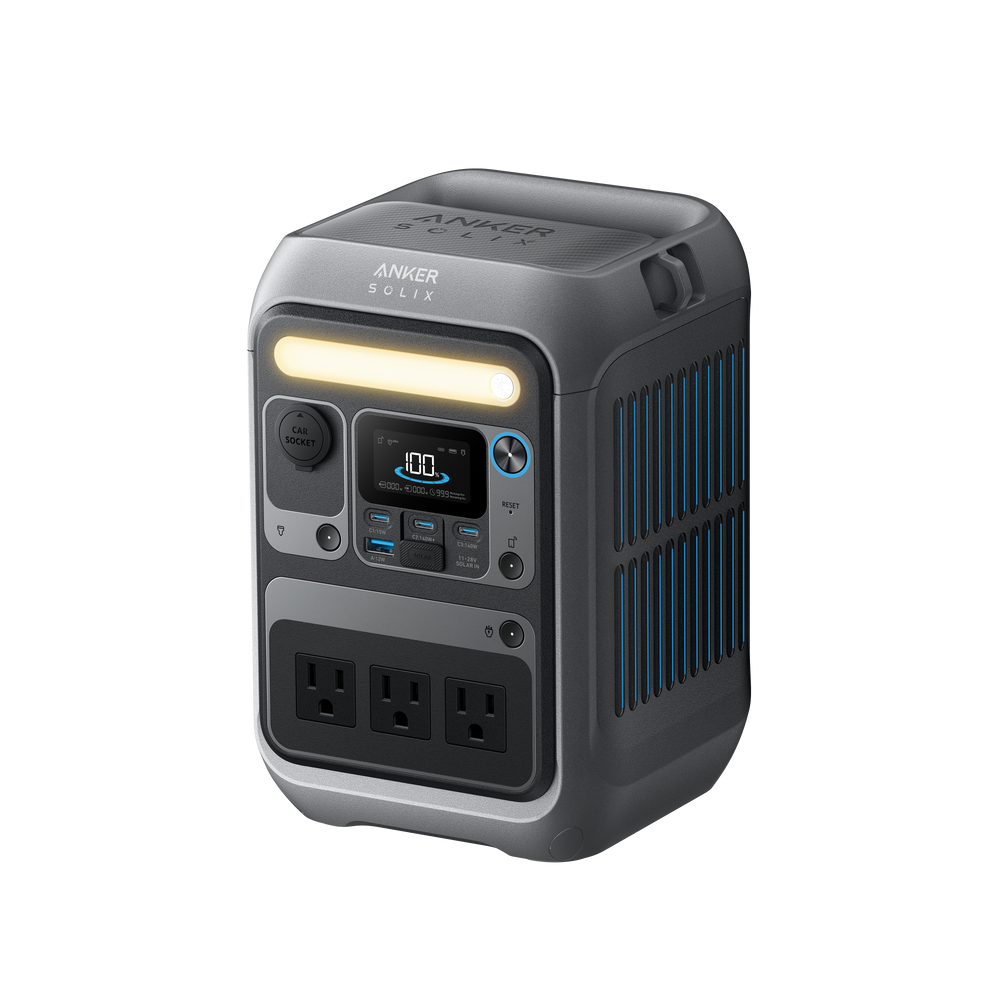
A 9.1 lb vertical LiFePO4 station delivering 300W AC, dual 140W USB-C ports, and <10 ms UPS backup for routers, laptops, and day trips — just don't confuse it with the DC-only C300 DC or expect appliance runtime.
Frequently Asked Questions
What makes the 6th-generation Goal Zero Yeti 700 different from older Yeti models?+
Older Goal Zero Yeti X models (such as the Yeti 500X or 1000X) used NMC lithium-ion cells with roughly 500–800 cycle lifespans and lacked splash sealing. The 6th-generation Yeti 700 upgrades to LiFePO4 (LFP) chemistry rated for 4,000 cycles to 80% capacity, integrates 500W fast AC charging, adds a 5-year warranty, and features an IPX4 weather-resistant housing.
Is the Goal Zero Yeti 700 completely waterproof?+
No. Its IPX4 rating protects the exterior housing against light rain splashes and camp spray only when all protective rubber port covers are firmly closed. It must never be submerged or left uncovered in heavy downpours with cables plugged in.
Can the Goal Zero Yeti 700 run a 1,000W microwave or coffee maker?+
No. With a 600W continuous AC inverter and 1,000W peak surge ceiling, it cannot power 1,000W–1,500W kitchen appliances, hair dryers, or space heaters—it is engineered for 12V camp refrigerators, laptops, cameras, CPAP machines, and light electronics.
Sources & Technical References
- View Source →[1]Manufacturer SpecificationGoal Zero OfficialVerified 2026-11-24Goal Zero Yeti 700 Portable Power Station Specifications
677Wh LFP, 600W AC, 1,000W surge, 200W solar max, IPX4 weather-resistant chassis, 5-year warranty.
- View Source →[2]Government Research ResourceNational Renewable Energy Laboratory (NREL)Verified 2026-11-24PVWatts & US Peak Sun Hours Reference Data
Documents regional peak sun hours and real-world photovoltaic derating factors (ambient heat, angle, shading, controller loss).
Model & Brand Comparisons
Related Sizing Guides & Tools
- How to Choose a Portable Power Station: Complete Sizing & Spec Guide →
- Battery Storage, Temperature & Safety Guide: Protecting LiFePO4 Longevity →
- LiFePO4 (LFP) vs. NMC Batteries in Portable Power Stations: Cycle Life, Weight & Safety →
- Watt-Hours (Wh) vs. Watts (W) Explained: Capacity vs. Power Output →
- Calculate custom runtime for Goal Zero Yeti 700 →